Wire Inkwell into the interaction system your project already has: your own focus and interact logic — trace or overlap — calling the Ink Page Reader, the shipped Enhanced Input actions, page turns, flips, and closing.
This guide assumes the situation most projects are actually in.The scenario. Your project already has a working interaction system — or you are about
to build one, and it will be yours. Every interactable in the level inherits from a base
Blueprint — call it BP_InteractableActor — which owns the collision, the outline
highlight, the “Press E” prompt, and an Interact event your player pawn fires at
whatever it is looking at. You want a readable note to be one more interactable in that
system. You do not want Inkwell’s own trace, its own prompt, or its own key bindings.That works, and it is the intended path. The production pieces of Inkwell —
Ink Page Display (UInkPageDisplayComponent),
Ink Page Stack, the Ink Page actor, the
Ink Page widget, and the
Ink Page Reader (UInkPageReaderComponent) — contain no input
handling and no focus tracing whatsoever. They are services your interaction system
calls: your interact verb calls Begin Reading / End Reading on the reader, your
page-turn input calls Next Page / Previous Page, your flip input calls Flip
Page. That is the whole integration surface.
The Ink Page Interactor (UInkPageInteractorComponent) — along
with the demo pawn AInkwellReaderCharacter, AInkwellReaderGameMode, the Inkwell Exhibit
component, and WBP_InkwellReadPrompt — is demo and reference content, not recommended
for production. It exists so the showroom plays out of the box and so
you can read a complete working example of the calls this guide describes. In a project
with its own interaction system it is a second trace, a second prompt, and a second set of
key bindings. Replace it with the wiring below.
Everything below is Blueprint-only. Every Inkwell function named here is
BlueprintCallable or BlueprintPure — on a component you add from the Components panel,
or on the Ink Page widget you drag in from the UMG palette.
Open the Blueprint you want to be readable. Either an existing interactable, or a new
child of your base class: right-click BP_InteractableActor and choose Create Child
Blueprint Class, then name it BP_ReadableNote.
In the Components panel, click Add and search for Ink Page Display.
(It is in the Inkwell class group; the C++ class is UInkPageDisplayComponent.)
Select the new component and set Document (category Inkwell | Page) to your
Ink Page Document asset.
Leave Page Index at 0.
That is the whole world-side setup. Preview In Editor is on by default, so the page
appears on the actor in the level viewport without pressing Play. Your base class is
untouched — Inkwell added a component, it did not replace anything, so your collision,
focus, save flags, and quest hooks all keep working.
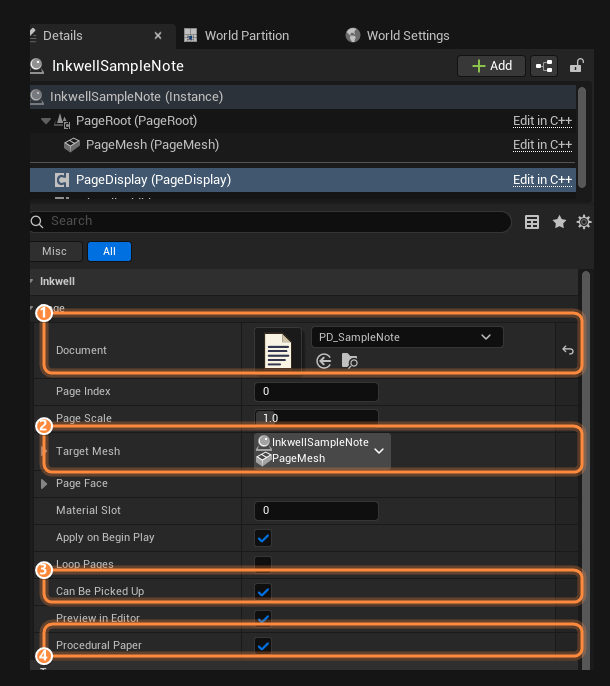
An Ink Page Display component in the Details panel.
The properties that matter when you are integrating:
Property
Type
Default
What it does
Document (Document)
Ink Page Document
None
The authored page content to show. Writable from Blueprint; Set Document swaps it and re-bakes.
Page Index (PageIndex)
Integer
0
Which page is shown. Out-of-range values are clamped.
Page Scale (PageScale)
Float
1.0
Multiplies the document’s authored size for this component only. Both axes together, so the writing never stretches.
Target Mesh (TargetMesh)
Component reference
None
The mesh the page is drawn onto. Empty = the first mesh component found on the actor, so this is only worth setting on an actor carrying several. The dropdown fills in on a placed actor; in a Blueprint you type the component’s variable name into Component Property Name underneath instead.
Page Face (FaceMapping)
Ink Page Face Mapping
Full UV Range
Where on the target mesh’s UVs the page lands, with quarter-turn rotation. Only needed for a mesh that was not unwrapped for Inkwell.
Material Slot (MaterialSlot)
Integer
0
Which material slot on the target mesh the page is drawn into.
Apply On Begin Play (bApplyOnBeginPlay)
Bool
true
Draw the page when play starts. Turn off to reveal it yourself later with Refresh.
Loop Pages (bLoopPages)
Bool
false
Wrap from the last page back to the first when turning pages.
Can Be Picked Up (bAllowReading)
Bool
true
Whether interaction should offer this page for reading. The demo interactor honors it; your focus code should read it too — it is the “this poster is scenery” flag. Writable at runtime, so a page can be locked until a quest step.
Preview In Editor (bPreviewInEditor)
Bool
true
Bake the page live in the level viewport, without PIE.
Procedural Paper (bProceduralPaper)
Bool
true
Spawn and size a paper sheet when the actor has no mesh of its own. See the next step.
2
Decide where the page is drawn: your mesh, or Inkwell's sheet
The component draws onto exactly one mesh, resolved in this order: the explicit
Target Mesh pick, then the first mesh component on the actor, and only if there is
no mesh at all, the sheet Procedural Paper spawns.
Use your own mesh
Let Inkwell make the sheet
Set Target Mesh with the component picker to the mesh that should carry the
page — the folded letter, the clipboard, the page face of a book prop. Or leave it
empty and let the component find the actor’s first mesh component.What this choice implies:
Inkwell replaces the material in Material Slot with a dynamic instance of
the page ink material, and pushes the baked ink plus the document’s paper
settings into it. Whatever material was in that slot is gone, for that slot. (The
exceptions are the document paper modes Custom Material — your material, with
the MF_InkwellPageInk function in it, replaces the slot — and Mesh’s Own
Material, which replaces nothing and drives the ink into the material the mesh
already wears. See Paper.)
The mesh needs clean 0–1 UVs across the page face — or a Page Face
mapping that says which UV rectangle the face actually occupies. Without either,
an atlas-mapped prop mesh garbles the text.
Inkwell never resizes your mesh. The page’s aspect ratio comes from the
document’s Page Size Pixels; if your mesh face is not that shape, the writing
is stretched to fit it. Match the mesh to the document’s aspect — Get Effective
Page Size Cm on the component gives you the exact centimeters — or accept the
distortion.
Procedural Paper does nothing while the actor supplies a mesh. It is a
fallback, never a takeover: it can never replace a prop you provided.
Leave Target Mesh empty, leave Procedural Paper on, and give the actor no
mesh component of its own.What this choice implies:
A static mesh component is spawned at registration, attached to the actor’s root,
and given the project’s page sheet mesh (/Inkwell/Meshes/SM_PageSheet —
repointable in Settings).
It is sized from the document: Page Width Cm, with the height derived from
the page’s aspect ratio, multiplied by Page Scale. Swap in a document authored
at a different size and the sheet resizes itself, live in the editor viewport.
The sheet is transient. It is derived state, respawned from the document on
load, and never saved into the level.
Its collision is query-only, blocking exactly one channel: Visibility. It
ignores every other channel, so it never blocks the player, physics, AI sight,
hitscan, or the camera. If your focus trace runs on a custom channel, that trace
passes straight through the sheet — see the next step.
The actor needs a root component for the sheet to attach to.
A base BP_InteractableActor usually already has a mesh component — often an empty
StaticMesh component with no mesh assigned. That still counts as “the actor
supplies a mesh”, so no sheet is spawned and the page is drawn onto an invisible
mesh. Either assign a real mesh to that component and point Target Mesh at it,
or derive the readable from a base class that has no mesh component.
3
Point your own focus logic at the page
Inkwell does not care how you decide the player is aiming at a readable — a view
trace, an overlap volume, a targeting system. Whatever you use, the question it has to
answer is the same: does this actor carry an Ink Page Display, and may it be read?If your system traces (the common case): your existing line trace hits the actor —
its own collision, or Inkwell’s spawned sheet on the Visibility channel. From the
hit actor: Get Component by Class, Component Class = Ink Page Display. The
return pin is typed from the class pick, so no Cast To node is needed. Valid, and
its Can Be Picked Up is true → show your “read” prompt.If your system overlaps: same two nodes, from the overlapping actor on your begin-
and end-overlap events. Nothing about Inkwell needs a trace.Two channel facts to get right:
The spawned sheet answers only Visibility. If your focus trace runs on a custom
trace channel, either trace against the actor’s own collision instead, or set a
response on the sheet yourself: Get Procedural Paper Mesh on the display →
Set Collision Response To Channel (your channel, Block) after Begin Play.
Ink Page Stack sheets answer only their own Sheet Trace Channel (default
Visibility). Set every stack’s Sheet Trace Channel to match your trace channel,
or the stack never registers under your crosshair — with no warning anywhere.
An Ink Page actor also offers Notify Focus Changed and
Notify Interacted — call them from your system and implement the matching On
Focus Changed / On Interacted events on the actor, if you prefer the reaction
logic to live on the prop rather than the pawn.
4
Open the reading view from your Interact event
Now the only Inkwell-specific wiring in the whole integration: what your existing
Interact event does. Two shapes — pick one.
Drive an Ink Page Reader (page floats up in the world)
Show it on screen (UMG)
The Ink Page Reader (UInkPageReaderComponent) contains no
input handling whatsoever. It is a pure “float this page up to the camera and put it
back afterwards” service that you call. It is a production component — only its
optional flip-key convenience touches input, and that is a checkbox.On the player pawn, once:
Components → Add → Ink Page Reader. Do not add an Ink Page Interactor.
The defaults are tuned: Fit Page To View (true) computes the hold distance
from the page’s real size and the camera FOV, so a poster and a sticky note both
fill View Fill Fraction (0.75) of the screen, clamped between Min View
Distance (18 cm) and Max View Distance (90 cm). Untick it to use the flat
View Distance (45 cm) instead. Keep Clear Of Obstructions (true) traces
so the held page is never buried in a desk or podium.
If you will bind the flip to your own input, untick Bind Flip Key — on by
default, it binds Flip Key (F) directly on the pawn, without consuming, so a
two-sided page can be turned over out of the box.
In BP_ReadableNote, override your base class’s interact event:
From the interacting pawn (your event’s instigator pin) → Get Component by
Class, Component Class = Ink Page Reader.
→ Is Reading → Branch.
True → End Reading, so the same key closes the page.
False → Begin Reading Actor, Page Actor = Self.
Begin Reading Actor finds the Ink Page Display on the actor for you. It returns
false when there is none, when something is already being read, or when the display
has no owning actor. Begin Reading takes the component directly if you already
have it in hand.
The reader does not check Can Be Picked Up — that filter belongs to the
focus side. Read it in your focus code (previous step) before offering the
interaction at all.
The reader moves the whole page actor to the camera: it saves the actor’s
transform, switches off physics simulation and collision for the ride, blends the
actor up, and puts it back exactly where it was on End Reading. Set the readable
actor’s root Mobility to Movable, and do not use this path for a page printed
on a desk, a door, or anything else that must stay put — use the widget tab for
those, or set dressing’s Can Be Picked Up to false and let it stay scenery.
Reading Rotation Offset (default Pitch 0, Yaw 90, Roll 90) is tuned for the
Inkwell page sheet: a flat plane whose printed face points up. If you read from your
own mesh and the page arrives face-down or sideways, this is the property to change.
Nothing moves in the world. The page is drawn full-screen by the same bake code, so
it looks identical to the in-world sheet.Build the reading widget, once:
Create a Widget Blueprint, WBP_PageReader.
In the palette, under the Inkwell category, drag an Ink Page widget
(UInkPageWidget) onto the canvas and tick Is Variable. Name it PageView.
It scales to fit whatever slot you give it, keeping the page’s aspect ratio.
Add your own close button and page buttons around it if you want them.
In BP_ReadableNote, on your interact event:
Create Widget, Class = WBP_PageReader, Owning Player = Get Player
Controller. Promote the return value to a variable, ActiveReader.
Drag from the Ink Page Display component and get its Document variable.
On the widget: Set Document (Target = PageView), New Document = that
document, New Page Index = the display’s Get Current Page Index. The widget’s
Document property is read-only in Blueprint on purpose — going through Set
Document is what rebuilds the page.
Add to Viewport.
Set Input Mode UI Only (or Game And UI) and Set Show Mouse Cursor if
your close and turn controls are mouse-driven.
The widget also exposes Show Paper — draw the document’s paper behind the
writing, or turn it off to print ink straight onto your own UI background — and
Apply Ink Tint.
5
Turn pages — and flip them — from your own input
Page turning is two nodes plus a guard. Bind them wherever your project already handles
input: an Enhanced Input action, a UMG button, a gamepad face button.Reader path — a page floating in front of the camera:
your “next page” input → the pawn’s Ink Page Reader → Next Page
your “previous page” input → the pawn’s Ink Page Reader → Previous Page
your “flip” input → Flip Page (only if you turned Bind Flip Key off)
The reader turns in book order: on a sheet with an authored back, Next Page
turns the sheet over to its back first and only then moves to the next page, and
Previous Page returns from a back to its front before retreating a page. So your
two page-turn inputs already read a two-sided document completely — Flip Page is
the direct “turn it over” verb on top of that. All three return false when nothing is
being read (and the page-turns also when there is nowhere further to go), so you can
drive prompt feedback straight off the return value. For a “Front / Back” label, bind
On Reading Side Changed — it fires exactly when the visible face changes — and
Get Reading Side Text hands you the word ready-made.Widget or direct path — no reader involved: call Next Page / Previous Page
on the Ink Page Display component, the Ink Page widget, or the Ink Page actor. On the
display component, Loop Pages decides whether the last page wraps back to the first.
(The flip is a reader presentation; the display and widget show one face at a time.)Knowing when you are on the last page. The display component owns that knowledge,
and the reader hands you the display:
your “next page” input → reader → Is Reading → Branch (False → do nothing).
True → reader → Get Current Page, which returns the Ink Page Display being read.
→ Is On Last Page → Branch.
True → reader → End Reading — “one more press closes the note”.
False → reader → Next Page.
Check Is On Last Pagebefore calling Next Page, not after: Next Page
changes the answer. Is On First Page is the mirror image, useful for graying out a
“back” prompt.For a “page 2 / 5” counter or a page-turn sound, bind On Page Changed on the display
component. It fires with New Page Index and Page Count every time the shown page
changes — including on Set Document — from any source, so one binding covers your
input, a cutscene, and a Blueprint that jumps straight to a specific page. (A flip never
fires it: turning a sheet over does not change which page is shown.)
6
Close, and give control back
Reader path. Call End Reading on the reader. It blends the actor back to exactly
where it was lying — starting the descent from wherever the page actually is, flipped
pages turning face-up on the way down — restores its collision and any physics
simulation it switched off, and releases the movement and look locks. The locks release
the moment End Reading is called, not when the page finishes floating down, so the
player is never left standing still watching paper land.Widget path. Call Remove from Parent on your stored widget reference, then Set
Input Mode Game Only and Set Show Mouse Cursor (false) to undo whatever you set on
open.Your HUD. The reader broadcasts On Reading Started and On Reading Ended, both
carrying the Ink Page Display being read (it can be None if the page actor was destroyed
mid-read). Bind them on the pawn to hide your interaction prompt, crosshair, or outline
highlight, and to restore them afterwards. Nothing about movement or camera needs any
wiring: Lock Movement While Reading and Lock Look While Reading apply and release
themselves.
If your pawn’s input is Enhanced Input, /Inkwell/Examples/Input/ saves you four assets:
IA_Interact, IA_NextPage, IA_PreviousPage, and IA_PutBack — plain digital
button actions with no logic in them — plus IMC_InkwellDefault, a ready-made Input
Mapping Context binding them to E, Right, Left, and Q, with mouse wheel
variants of the two page turns. Use them as-is, add
the four actions to your own mapping context under your own keys, or ignore them and use
your own actions; they are names, nothing more.To wire them straight to the reader:
On your pawn’s Begin Play: Get Controller → Cast To Player Controller →
Enhanced Input Local Player Subsystem → Add Mapping Context, Mapping Context =
IMC_InkwellDefault (or your own IMC carrying the four actions).
In the pawn’s Event Graph, add the four Enhanced Input events and, from the pawn’s Ink
Page Reader:
Action event (Triggered)
Call on the reader
IA_Interact
Is Reading → Branch: True → End Reading; False → Begin Reading Actor with your focused actor
IA_NextPage
Next Page
IA_PreviousPage
Previous Page
IA_PutBack
End Reading
The focused actor in that first row comes from your focus logic — the shipped actions
deliberately carry no trace of their own.
The bundled interaction pieces exist so an empty project is readable out of the box and so
the showroom is a complete worked reference. In a project that has its own interaction
system they are duplicates, and they will fight you.The Ink Page Interactor’s trace. It line-traces from the player’s view every Focus
Check Interval (0.1 s) out to Interaction Distance (300 cm) on Trace Channel
(Visibility), and raises its own On Focus Changed. Running it alongside your own focus
system gives you two sources of truth for “what am I looking at”, two prompts to keep in
sync, and a second definition of interaction range.Its key bindings. With Enable Default Input on — the default — the interactor binds
keys directly on the owning pawn: Interact Key (E) to interact, Put Back Key (Q) to
close, Previous Page Key (Left) or mouse wheel down for the previous page, Next Page
Key (Right) or mouse wheel up for the next. Those bindings sit underneath your input
system and will double-fire your own interact key.The demo pawn, game mode, prompt widget, and exhibit component.AInkwellReaderCharacter, AInkwellReaderGameMode, WBP_InkwellReadPrompt, and the
Inkwell Exhibit component are the showroom’s furniture — read them as the worked example
they are (Example content walks through each), and leave them there.
If you want the interactor’s trace but not its keys, that hybrid is supported: add the
component, untick Enable Default Input, and call Interact, Stop Reading, Next
Page, and Previous Page from your own bindings. It is still a second trace — worth it
only if your own system cannot report what the player is looking at.
Your trace channel and the sheet disagree. The spawned procedural sheet blocks
only the Visibility channel; an Ink Page Stack’s sheets answer only their
Sheet Trace Channel. Trace Visibility, set the stack’s channel to yours, or add a
response to the spawned sheet via Get Procedural Paper Mesh → Set Collision
Response To Channel.
You traced for the component’s class. Trace for the actor, then Get Component
by Class — the display component has no collision of its own.
The actor’s own collision swallowed the hit in front of the page mesh, and your
code only checked the hit component. Check the hit actor for the component.
The page is blank
Work down this list, and check the Output Log for LogInkwell — the misconfiguration
cases below log Warnings naming the actor:
No document assigned. A display with no Document deliberately draws a blank
sheet — the fully transparent “no ink” texture over the paper — rather than leaving
whatever was in the material slot before. Blank paper means “no document”, not
“broken”.
The text layer is hidden, empty, or at zero opacity. A page is a stack of layers,
and hidden layers are skipped by the bake exactly as they are in the editor preview.
Open the document and check the eye toggles and layer opacities in the
Layers panel.
The document’s Paper Mode is “Mesh’s Own Material” and the mesh’s material has no
MF_InkwellPageInk. In that mode the ink is driven into the material the mesh
already wears; a material without the function shows no ink and raises no error —
that is the contract. Add the function to the material, or use another paper mode.
The page ink material is missing. If Page Ink Material in Project Settings →
Plugins → Inkwell cannot be loaded, Inkwell falls back to whatever material the mesh
already had, where the ink parameters do nothing. The Output Log carries one warning
per session naming the setting.
You are on a dedicated server or in a null-RHI build. Baking a page paints a Slate
widget into a render target; with no Slate renderer there is no bake. Pages are a
client-side visual.
The text is stretched, squashed, or garbled
Almost always the mesh, not the document. By default the bake is mapped across the full
0–1 UV range of the page face, and the page’s shape comes from the document’s Page
Size Pixels aspect ratio.
The mesh face is a different shape than the page. Inkwell never resizes a mesh you
supplied. Scale the mesh to the document’s aspect — Get Effective Page Size Cm on
the display component gives you the exact centimeters — or let Procedural Paper
make the sheet, which is the right shape by construction.
The mesh’s page face does not span 0–1 UVs. Set the component’s Page Face:
Auto Fit measures the UV rectangle the face actually occupies, Custom Region
takes the rectangle you type, and Rotation Quarter Turns rights an unwrap that
runs sideways.
You scaled the actor non-uniformly. X and Y at different scales distorts the page
like any other texture. Use Page Scale instead: it scales both dimensions together
precisely so this cannot happen.
You cannot cause this by authoring: Page Width Cm is the only physical dimension a
document has, and the height is derived from it, so the paper always has the shape of the
page you wrote.
No paper appears at all
Procedural Paper is a fallback, and it steps aside whenever the actor supplies a
mesh. The usual causes, in order:
The actor already has a mesh component — including an empty one inherited from
your interactable base class, with no static mesh assigned. The page is being drawn
onto that invisible mesh. Assign a mesh to it, or point Target Mesh at a mesh that
actually renders.
Target Mesh points at something that is not a mesh component. The pick is ignored,
and the component falls back to searching the actor.
The actor has no root component, so there is nothing for the sheet to attach to.
This logs its own Warning on LogInkwell.
Procedural Paper is off on a mesh-less actor, which is the “draw nothing” setting.
You used an Ink Page Stack. A stack always builds its own pile of sheets, one per
page, so the inherited Procedural Paper toggle is grayed out and does nothing.
The “no mesh to draw onto” case logs a Warning from LogInkwell naming the actor.
Editing the document does not change what is in the level
Editing a document from the Page Editor or the Details panel
re-bakes and re-sizes every placed page in every editor world that shows it, so this
should be immediate.
Preview In Editor is off on that component. That is the switch for level-viewport
baking; turn it back on.
You are in PIE, or in a packaged build. Displays do not watch their document.
After changing a document at runtime, call Refresh on each component, widget, or
actor currently showing it: the mutation invalidates the cached bake, but the material
already applied keeps the texture it was handed. See
Runtime documents.
You edited the Blueprint’s component default while a placed instance overrides it.
Standard Blueprint behavior — check the placed actor’s own Details panel.
The bake failed during editor startup. A map opened by a startup script can
register before the Slate renderer is usable. Inkwell retries with backoff and logs a
warning if it gives up; touching the actor or reopening the map fixes it.
The reading pose, the fit-to-view math, the flip, and the movement and look locks in full.
Ink Page Display
Every property, function, and event on the component this guide is built around.
Runtime documents
Write pages from gameplay: generated notes, journals that grow, documents built in play.
{"docsConfig":{"theme":"mint","$schema":"https://mintlify.com/docs.json","name":"Teriyaki Gaming","colors":{"primary":"#3E7C59","light":"#9DC08B","dark":"#2E5C42"},"logo":{"light":"https://mintcdn.com/teriyaki-gaming/Re9zDOvKF1471rVG/logo/light.svg?fit=max\u0026auto=format\u0026n=Re9zDOvKF1471rVG\u0026q=85\u0026s=9a862161962dd66d099129095f3c5f3a","dark":"https://mintcdn.com/teriyaki-gaming/Re9zDOvKF1471rVG/logo/dark.svg?fit=max\u0026auto=format\u0026n=Re9zDOvKF1471rVG\u0026q=85\u0026s=f4855dde947be30313d5c3441a026eea"},"favicon":"https://mintcdn.com/teriyaki-gaming/lWew69cnc3CohWUG/favicon.svg?fit=max\u0026auto=format\u0026n=lWew69cnc3CohWUG\u0026q=85\u0026s=898db809dce8aa888bcceb5be4cda06b","footer":{"socials":{"github":"https://github.com/tyguymedia"}},"contextual":{"options":["copy","view"],"display":"header"},"styling":{"latex":false},"navigation":{"pages":[]}},"deployment":{"deploymentMetadataValue":{"subdomain":"teriyaki-gaming","hasAudioNarration":false,"actualSubdomain":"teriyaki-gaming","customDomains":["docs.teriyakigaming.com"],"gitSource":{"type":"github","owner":"tyguymedia","repo":"teriyakigaming-site","deployBranch":"main","contentDirectory":"docs","isPrivate":true,"mountPath":"","label":""},"chroma":{"latestBuiltDeploymentHistoryId":"6a8db7a9f751bf22e13d95af","collectionId":"6f0199bb-c8ed-4bdf-ab20-c7697fa048dd","liveDeploymentHistoryId":"6a8db7a9f751bf22e13d95af","schemaVersion":"v3"},"entitlements":{"AI_CHAT":{"status":"DISABLED"}},"buildId":"6a8db7a9f751bf22e13d95af","clientVersion":"0.0.3939","searchFilterCounts":[{"language":"default","tag":"Inkwell","count":23},{"language":"default","tag":"Authoring","count":6},{"language":"default","tag":"Components","count":6},{"language":"default","tag":"Guides","count":4},{"language":"default","tag":"Reference","count":4},{"language":"default","tag":"Get Started","count":3},{"language":"default","tag":"Overview","count":1},{"language":"default","tag":"Getting started","count":1}]},"assistantConfig":{"enableAskAiButton":false,"enableStarterQuestions":false,"enableContextualStarterQuestions":false,"enableAskAiSearchBar":true},"hasChatPermissions":false,"hasWebMcpPermissions":false,"toggles":[{"name":"kill-isr","enabled":true,"variant":{"name":"disabled","enabled":false,"feature_enabled":true},"impressionData":false},{"name":"agent-mintlify-slack","enabled":true,"variant":{"name":"disabled","enabled":false,"feature_enabled":true},"impressionData":false},{"name":"editor-v7-file-tree","enabled":true,"variant":{"name":"disabled","enabled":false,"feature_enabled":true},"impressionData":false},{"name":"agent-integrations-settings","enabled":true,"variant":{"name":"disabled","enabled":false,"feature_enabled":true},"impressionData":false},{"name":"automations-pr-grouping","enabled":true,"variant":{"name":"disabled","enabled":false,"feature_enabled":true},"impressionData":false},{"name":"custom-prefix","enabled":true,"variant":{"name":"disabled","enabled":false,"feature_enabled":true},"impressionData":false},{"name":"analytics-v7","enabled":true,"variant":{"name":"disabled","enabled":false,"feature_enabled":true},"impressionData":false},{"name":"user-flows-analytics","enabled":true,"variant":{"name":"disabled","enabled":false,"feature_enabled":true},"impressionData":false},{"name":"no-publish-flow","enabled":true,"variant":{"name":"disabled","enabled":false,"feature_enabled":true},"impressionData":false},{"name":"workos-onboarding","enabled":true,"variant":{"name":"disabled","enabled":false,"feature_enabled":true},"impressionData":false},{"name":"llms-txt-v2","enabled":true,"variant":{"name":"disabled","enabled":false,"feature_enabled":true},"impressionData":false},{"name":"pause-universal-search-reconcile","enabled":true,"variant":{"name":"disabled","enabled":false,"feature_enabled":true},"impressionData":false},{"name":"snapshot-serving-live","enabled":true,"variant":{"name":"disabled","enabled":false,"feature_enabled":true},"impressionData":false},{"name":"stripTemperatureMiddleware","enabled":true,"variant":{"name":"disabled","enabled":false,"feature_enabled":true},"impressionData":false},{"name":"per-site-search-delta","enabled":true,"variant":{"name":"disabled","enabled":false,"feature_enabled":true},"impressionData":false},{"name":"support-platform-pylon-zendesk","enabled":true,"variant":{"name":"disabled","enabled":false,"feature_enabled":true},"impressionData":false},{"name":"snapshot-serving","enabled":true,"variant":{"name":"disabled","enabled":false,"feature_enabled":true},"impressionData":false},{"name":"instant-rollback","enabled":true,"variant":{"name":"disabled","enabled":false,"feature_enabled":true},"impressionData":false},{"name":"granular-notifications-server","enabled":true,"variant":{"name":"disabled","enabled":false,"feature_enabled":true},"impressionData":false},{"name":"granular-notifications","enabled":true,"variant":{"name":"disabled","enabled":false,"feature_enabled":true},"impressionData":false},{"name":"editor-private-page-search","enabled":true,"variant":{"name":"disabled","enabled":false,"feature_enabled":true},"impressionData":false},{"name":"automations-fable","enabled":true,"variant":{"name":"disabled","enabled":false,"feature_enabled":true},"impressionData":false},{"name":"fixed-ai-action-pricing","enabled":true,"variant":{"name":"disabled","enabled":false,"feature_enabled":true},"impressionData":false},{"name":"automation-resolve-merge-conflict","enabled":true,"variant":{"name":"disabled","enabled":false,"feature_enabled":true},"impressionData":false},{"name":"scoped-publishing","enabled":true,"variant":{"name":"disabled","enabled":false,"feature_enabled":true},"impressionData":false},{"name":"mintql","enabled":true,"variant":{"name":"disabled","enabled":false,"feature_enabled":true},"impressionData":false},{"name":"page-level-analytics","enabled":true,"variant":{"name":"disabled","enabled":false,"feature_enabled":true},"impressionData":false},{"name":"editor-version-history-v2","enabled":true,"variant":{"name":"disabled","enabled":false,"feature_enabled":true},"impressionData":false},{"name":"editor-nav-generations","enabled":true,"variant":{"name":"disabled","enabled":false,"feature_enabled":true},"impressionData":false},{"name":"billing-page-v2","enabled":true,"variant":{"name":"disabled","enabled":false,"feature_enabled":true},"impressionData":false},{"name":"workspace-projects","enabled":true,"variant":{"name":"disabled","enabled":false,"feature_enabled":true},"impressionData":false},{"name":"assistant-v5","enabled":true,"variant":{"name":"disabled","enabled":false,"feature_enabled":true},"impressionData":false},{"name":"byok-sep-25","enabled":true,"variant":{"name":"disabled","enabled":false,"feature_enabled":true},"impressionData":false},{"name":"fork-pr-previews","enabled":true,"variant":{"name":"disabled","enabled":false,"feature_enabled":true},"impressionData":false},{"name":"revalidation-jwt","enabled":true,"variant":{"name":"disabled","enabled":false,"feature_enabled":true},"impressionData":false},{"name":"vite-origin","enabled":true,"variant":{"name":"disabled","enabled":false,"feature_enabled":true},"impressionData":false},{"name":"editor-agent-model-picker","enabled":true,"variant":{"name":"disabled","enabled":false,"feature_enabled":true},"impressionData":false},{"name":"billing-updated-9-15","enabled":true,"variant":{"name":"disabled","enabled":false,"feature_enabled":true},"impressionData":false},{"name":"hobby-abuse-scan","enabled":true,"variant":{"name":"disabled","enabled":false,"feature_enabled":true},"impressionData":false},{"name":"dashboard-inbox","enabled":true,"variant":{"name":"disabled","enabled":false,"feature_enabled":true},"impressionData":false}],"isAtlas":false,"googleFontsInlined":false},"customCss":[],"page":{"pagePath":"plugins/inkwell/guides/integration","slug":"/plugins/inkwell/guides/integration","pageMetadata":{"title":"Integrating with your interaction system","description":"Wire Inkwell into the interaction system your project already has: your own focus and interact logic — trace or overlap — calling the Ink Page Reader, the shipped Enhanced Input actions, page turns, flips, and closing.","icon":"plug","href":"/plugins/inkwell/guides/integration"},"description":{"compiledSource":"\"use strict\";\nconst {jsx: _jsx} = arguments[0];\nconst {useMDXComponents: _provideComponents} = arguments[0];\nfunction _createMdxContent(props) {\n const _components = {\n p: \"p\",\n ..._provideComponents(),\n ...props.components\n };\n return _jsx(_components.p, {\n children: \"Wire Inkwell into the interaction system your project already has: your own focus and interact logic — trace or overlap — calling the Ink Page Reader, the shipped Enhanced Input actions, page turns, flips, and closing.\"\n });\n}\nfunction MDXContent(props = {}) {\n const {wrapper: MDXLayout} = {\n ..._provideComponents(),\n ...props.components\n };\n return MDXLayout ? _jsx(MDXLayout, {\n ...props,\n children: _jsx(_createMdxContent, {\n ...props\n })\n }) : _createMdxContent(props);\n}\nreturn {\n default: MDXContent\n};\n","frontmatter":{},"scope":{}},"pageType":"default","mdx":{"mdxSource":{"compiledSource":"\"use strict\";const{Fragment:_Fragment,jsx:_jsx,jsxs:_jsxs}=arguments[0];const{useMDXComponents:_provideComponents}=arguments[0];function _createMdxContent(props){const _components={a:`a`,code:`code`,em:`em`,li:`li`,ol:`ol`,p:`p`,strong:`strong`,tbody:`tbody`,td:`td`,th:`th`,thead:`thead`,tr:`tr`,ul:`ul`,..._provideComponents(),...props.components},{Accordion,AccordionGroup,Card,CardGroup,Frame,Heading,Note,OptimizedImage,Step,Steps,Tab,Table,Tabs,Tip,Warning}=_components;if(!Accordion)_missingMdxReference(`Accordion`,true);if(!AccordionGroup)_missingMdxReference(`AccordionGroup`,true);if(!Card)_missingMdxReference(`Card`,true);if(!CardGroup)_missingMdxReference(`CardGroup`,true);if(!Frame)_missingMdxReference(`Frame`,true);if(!Heading)_missingMdxReference(`Heading`,true);if(!Note)_missingMdxReference(`Note`,true);if(!OptimizedImage)_missingMdxReference(`OptimizedImage`,true);if(!Step)_missingMdxReference(`Step`,true);if(!Steps)_missingMdxReference(`Steps`,true);if(!Tab)_missingMdxReference(`Tab`,true);if(!Table)_missingMdxReference(`Table`,true);if(!Tabs)_missingMdxReference(`Tabs`,true);if(!Tip)_missingMdxReference(`Tip`,true);if(!Warning)_missingMdxReference(`Warning`,true);return _jsxs(_Fragment,{children:[_jsx(_components.p,{children:`This guide assumes the situation most projects are actually in.`}),`\n`,_jsxs(_components.p,{children:[_jsx(_components.strong,{children:`The scenario.`}),` Your project already has a working interaction system — or you are about\nto build one, and it will be yours. Every interactable in the level inherits from a base\nBlueprint — call it `,_jsx(_components.code,{children:`BP_InteractableActor`}),` — which owns the collision, the outline\nhighlight, the “Press E” prompt, and an `,_jsx(_components.strong,{children:`Interact`}),` event your player pawn fires at\nwhatever it is looking at. You want a readable note to be one more interactable in that\nsystem. You do `,_jsx(_components.strong,{children:`not`}),` want Inkwell’s own trace, its own prompt, or its own key bindings.`]}),`\n`,_jsxs(_components.p,{children:[`That works, and it is the intended path. The production pieces of Inkwell —\n`,_jsx(_components.a,{href:`/plugins/inkwell/components/page-display`,children:`Ink Page Display`}),` (`,_jsx(_components.code,{children:`UInkPageDisplayComponent`}),`),\n`,_jsx(_components.a,{href:`/plugins/inkwell/components/page-stack`,children:`Ink Page Stack`}),`, the `,_jsx(_components.a,{href:`/plugins/inkwell/components/page-actor`,children:`Ink Page`}),` actor, the\n`,_jsx(_components.a,{href:`/plugins/inkwell/components/page-widget`,children:`Ink Page`}),` widget, and the\n`,_jsx(_components.a,{href:`/plugins/inkwell/components/reader`,children:`Ink Page Reader`}),` (`,_jsx(_components.code,{children:`UInkPageReaderComponent`}),`) — contain `,_jsx(_components.strong,{children:`no input\nhandling and no focus tracing whatsoever`}),`. They are services your interaction system\ncalls: your interact verb calls `,_jsx(_components.strong,{children:`Begin Reading`}),` / `,_jsx(_components.strong,{children:`End Reading`}),` on the reader, your\npage-turn input calls `,_jsx(_components.strong,{children:`Next Page`}),` / `,_jsx(_components.strong,{children:`Previous Page`}),`, your flip input calls `,_jsx(_components.strong,{children:`Flip\nPage`}),`. That is the whole integration surface.`]}),`\n`,_jsx(Warning,{children:_jsxs(_components.p,{children:[`The `,_jsx(_components.a,{href:`/plugins/inkwell/components/interactor`,children:`Ink Page Interactor`}),` (`,_jsx(_components.code,{children:`UInkPageInteractorComponent`}),`) — along\nwith the demo pawn `,_jsx(_components.code,{children:`AInkwellReaderCharacter`}),`, `,_jsx(_components.code,{children:`AInkwellReaderGameMode`}),`, the Inkwell Exhibit\ncomponent, and `,_jsx(_components.code,{children:`WBP_InkwellReadPrompt`}),` — is `,_jsx(_components.strong,{children:`demo and reference content, not recommended\nfor production`}),`. It exists so the `,_jsx(_components.a,{href:`/plugins/inkwell/guides/examples`,children:`showroom`}),` plays out of the box and so\nyou can read a complete working example of the calls this guide describes. In a project\nwith its own interaction system it is a second trace, a second prompt, and a second set of\nkey bindings. Replace it with the wiring below.`]})}),`\n`,_jsx(Note,{children:_jsxs(_components.p,{children:[`Everything below is Blueprint-only. Every Inkwell function named here is\n`,_jsx(_components.code,{children:`BlueprintCallable`}),` or `,_jsx(_components.code,{children:`BlueprintPure`}),` — on a component you add from the Components panel,\nor on the Ink Page widget you drag in from the UMG palette.`]})}),`\n`,_jsx(Heading,{level:`2`,id:`the-walkthrough`,children:`The walkthrough`}),`\n`,_jsxs(Steps,{children:[_jsxs(Step,{title:`Add an Ink Page Display to your interactable`,children:[_jsxs(_components.p,{children:[`Open the Blueprint you want to be readable. Either an existing interactable, or a new\nchild of your base class: right-click `,_jsx(_components.code,{children:`BP_InteractableActor`}),` and choose `,_jsx(_components.strong,{children:`Create Child\nBlueprint Class`}),`, then name it `,_jsx(_components.code,{children:`BP_ReadableNote`}),`.`]}),_jsxs(_components.ol,{children:[`\n`,_jsxs(_components.li,{children:[`In the `,_jsx(_components.strong,{children:`Components`}),` panel, click `,_jsx(_components.strong,{children:`Add`}),` and search for `,_jsx(_components.strong,{children:`Ink Page Display`}),`.\n(It is in the `,_jsx(_components.strong,{children:`Inkwell`}),` class group; the C++ class is `,_jsx(_components.code,{children:`UInkPageDisplayComponent`}),`.)`]}),`\n`,_jsxs(_components.li,{children:[`Select the new component and set `,_jsx(_components.strong,{children:`Document`}),` (category `,_jsx(_components.em,{children:`Inkwell | Page`}),`) to your\n`,_jsx(_components.a,{href:`/plugins/inkwell/authoring/documents`,children:`Ink Page Document`}),` asset.`]}),`\n`,_jsxs(_components.li,{children:[`Leave `,_jsx(_components.strong,{children:`Page Index`}),` at 0.`]}),`\n`]}),_jsxs(_components.p,{children:[`That is the whole world-side setup. `,_jsx(_components.strong,{children:`Preview In Editor`}),` is on by default, so the page\nappears on the actor in the level viewport without pressing Play. Your base class is\nuntouched — Inkwell added a component, it did not replace anything, so your collision,\nfocus, save flags, and quest hooks all keep working.`]}),_jsx(Frame,{caption:`An Ink Page Display component in the Details panel.`,children:_jsx(OptimizedImage,{src:`https://mintcdn.com/teriyaki-gaming/rfYUFiwAdsWmGZKv/images/inkwell/display-component-details.png?fit=max\u0026auto=format\u0026n=rfYUFiwAdsWmGZKv\u0026q=85\u0026s=b6ba38bb1a9544e5636c8b4cb8711609`,alt:`Details panel of an Ink Page Display component`,\"data-og-width\":`610`,width:`610`,\"data-og-height\":`686`,height:`686`,\"data-path\":`images/inkwell/display-component-details.png`,\"data-optimize\":`true`,\"data-opv\":`3`,srcset:`https://mintcdn.com/teriyaki-gaming/rfYUFiwAdsWmGZKv/images/inkwell/display-component-details.png?w=280\u0026fit=max\u0026auto=format\u0026n=rfYUFiwAdsWmGZKv\u0026q=85\u0026s=5edce8123023947888c40f9c2a3aedf8 280w, https://mintcdn.com/teriyaki-gaming/rfYUFiwAdsWmGZKv/images/inkwell/display-component-details.png?w=560\u0026fit=max\u0026auto=format\u0026n=rfYUFiwAdsWmGZKv\u0026q=85\u0026s=db76eb42011cb55a2f16ee49e395bbd7 560w, https://mintcdn.com/teriyaki-gaming/rfYUFiwAdsWmGZKv/images/inkwell/display-component-details.png?w=840\u0026fit=max\u0026auto=format\u0026n=rfYUFiwAdsWmGZKv\u0026q=85\u0026s=0d22a7f6dc7a7fc9afe2e7b63cde8218 840w, https://mintcdn.com/teriyaki-gaming/rfYUFiwAdsWmGZKv/images/inkwell/display-component-details.png?w=1100\u0026fit=max\u0026auto=format\u0026n=rfYUFiwAdsWmGZKv\u0026q=85\u0026s=e4fddb7d8bdf2cb8bab073313c10d697 1100w, https://mintcdn.com/teriyaki-gaming/rfYUFiwAdsWmGZKv/images/inkwell/display-component-details.png?w=1650\u0026fit=max\u0026auto=format\u0026n=rfYUFiwAdsWmGZKv\u0026q=85\u0026s=ae46327f5a5c918c7ba016d95bb2f9de 1650w, https://mintcdn.com/teriyaki-gaming/rfYUFiwAdsWmGZKv/images/inkwell/display-component-details.png?w=2500\u0026fit=max\u0026auto=format\u0026n=rfYUFiwAdsWmGZKv\u0026q=85\u0026s=68448b8bdb16400ac1c9a11c08705331 2500w`})}),_jsx(_components.p,{children:`The properties that matter when you are integrating:`}),_jsxs(Table,{children:[_jsx(_components.thead,{children:_jsxs(_components.tr,{children:[_jsx(_components.th,{children:`Property`}),_jsx(_components.th,{children:`Type`}),_jsx(_components.th,{children:`Default`}),_jsx(_components.th,{children:`What it does`})]})}),_jsxs(_components.tbody,{children:[_jsxs(_components.tr,{children:[_jsxs(_components.td,{children:[`Document (`,_jsx(_components.code,{children:`Document`}),`)`]}),_jsx(_components.td,{children:`Ink Page Document`}),_jsx(_components.td,{children:`None`}),_jsxs(_components.td,{children:[`The authored page content to show. Writable from Blueprint; `,_jsx(_components.strong,{children:`Set Document`}),` swaps it and re-bakes.`]})]}),_jsxs(_components.tr,{children:[_jsxs(_components.td,{children:[`Page Index (`,_jsx(_components.code,{children:`PageIndex`}),`)`]}),_jsx(_components.td,{children:`Integer`}),_jsx(_components.td,{\"data-numeric\":`true`,children:`0`}),_jsx(_components.td,{children:`Which page is shown. Out-of-range values are clamped.`})]}),_jsxs(_components.tr,{children:[_jsxs(_components.td,{children:[`Page Scale (`,_jsx(_components.code,{children:`PageScale`}),`)`]}),_jsx(_components.td,{children:`Float`}),_jsx(_components.td,{\"data-numeric\":`true`,children:`1.0`}),_jsx(_components.td,{children:`Multiplies the document’s authored size for this component only. Both axes together, so the writing never stretches.`})]}),_jsxs(_components.tr,{children:[_jsxs(_components.td,{children:[`Target Mesh (`,_jsx(_components.code,{children:`TargetMesh`}),`)`]}),_jsx(_components.td,{children:`Component reference`}),_jsx(_components.td,{children:`None`}),_jsxs(_components.td,{children:[`The mesh the page is drawn onto. Empty = the first mesh component found on the actor, so this is only worth setting on an actor carrying several. The dropdown fills in on a placed actor; in a Blueprint you type the component’s variable name into `,_jsx(_components.strong,{children:`Component Property Name`}),` underneath instead.`]})]}),_jsxs(_components.tr,{children:[_jsxs(_components.td,{children:[`Page Face (`,_jsx(_components.code,{children:`FaceMapping`}),`)`]}),_jsx(_components.td,{children:`Ink Page Face Mapping`}),_jsx(_components.td,{children:`Full UV Range`}),_jsx(_components.td,{children:`Where on the target mesh’s UVs the page lands, with quarter-turn rotation. Only needed for a mesh that was not unwrapped for Inkwell.`})]}),_jsxs(_components.tr,{children:[_jsxs(_components.td,{children:[`Material Slot (`,_jsx(_components.code,{children:`MaterialSlot`}),`)`]}),_jsx(_components.td,{children:`Integer`}),_jsx(_components.td,{\"data-numeric\":`true`,children:`0`}),_jsx(_components.td,{children:`Which material slot on the target mesh the page is drawn into.`})]}),_jsxs(_components.tr,{children:[_jsxs(_components.td,{children:[`Apply On Begin Play (`,_jsx(_components.code,{children:`bApplyOnBeginPlay`}),`)`]}),_jsx(_components.td,{children:`Bool`}),_jsx(_components.td,{children:`true`}),_jsxs(_components.td,{children:[`Draw the page when play starts. Turn off to reveal it yourself later with `,_jsx(_components.strong,{children:`Refresh`}),`.`]})]}),_jsxs(_components.tr,{children:[_jsxs(_components.td,{children:[`Loop Pages (`,_jsx(_components.code,{children:`bLoopPages`}),`)`]}),_jsx(_components.td,{children:`Bool`}),_jsx(_components.td,{children:`false`}),_jsx(_components.td,{children:`Wrap from the last page back to the first when turning pages.`})]}),_jsxs(_components.tr,{children:[_jsxs(_components.td,{children:[`Can Be Picked Up (`,_jsx(_components.code,{children:`bAllowReading`}),`)`]}),_jsx(_components.td,{children:`Bool`}),_jsx(_components.td,{children:`true`}),_jsxs(_components.td,{children:[`Whether interaction should offer this page for reading. The demo interactor honors it; `,_jsx(_components.strong,{children:`your focus code should read it too`}),` — it is the “this poster is scenery” flag. Writable at runtime, so a page can be locked until a quest step.`]})]}),_jsxs(_components.tr,{children:[_jsxs(_components.td,{children:[`Preview In Editor (`,_jsx(_components.code,{children:`bPreviewInEditor`}),`)`]}),_jsx(_components.td,{children:`Bool`}),_jsx(_components.td,{children:`true`}),_jsx(_components.td,{children:`Bake the page live in the level viewport, without PIE.`})]}),_jsxs(_components.tr,{children:[_jsxs(_components.td,{children:[`Procedural Paper (`,_jsx(_components.code,{children:`bProceduralPaper`}),`)`]}),_jsx(_components.td,{children:`Bool`}),_jsx(_components.td,{children:`true`}),_jsxs(_components.td,{children:[`Spawn and size a paper sheet `,_jsx(_components.strong,{children:`when the actor has no mesh of its own`}),`. See the next step.`]})]})]})]})]}),_jsxs(Step,{title:`Decide where the page is drawn: your mesh, or Inkwell's sheet`,children:[_jsxs(_components.p,{children:[`The component draws onto exactly one mesh, resolved in this order: the explicit\n`,_jsx(_components.strong,{children:`Target Mesh`}),` pick, then the first mesh component on the actor, and only if there is\nno mesh at all, the sheet `,_jsx(_components.strong,{children:`Procedural Paper`}),` spawns.`]}),_jsxs(Tabs,{children:[_jsxs(Tab,{title:`Use your own mesh`,id:`use-your-own-mesh`,children:[_jsxs(_components.p,{children:[`Set `,_jsx(_components.strong,{children:`Target Mesh`}),` with the component picker to the mesh that should carry the\npage — the folded letter, the clipboard, the page face of a book prop. Or leave it\nempty and let the component find the actor’s first mesh component.`]}),_jsx(_components.p,{children:`What this choice implies:`}),_jsxs(_components.ul,{children:[`\n`,_jsxs(_components.li,{children:[_jsx(_components.strong,{children:`Inkwell replaces the material`}),` in `,_jsx(_components.strong,{children:`Material Slot`}),` with a dynamic instance of\nthe page ink material, and pushes the baked ink plus the document’s paper\nsettings into it. Whatever material was in that slot is gone, for that slot. (The\nexceptions are the document paper modes `,_jsx(_components.strong,{children:`Custom Material`}),` — your material, with\nthe `,_jsx(_components.code,{children:`MF_InkwellPageInk`}),` function in it, replaces the slot — and `,_jsx(_components.strong,{children:`Mesh’s Own\nMaterial`}),`, which replaces nothing and drives the ink into the material the mesh\nalready wears. See `,_jsx(_components.a,{href:`/plugins/inkwell/authoring/paper`,children:`Paper`}),`.)`]}),`\n`,_jsxs(_components.li,{children:[_jsx(_components.strong,{children:`The mesh needs clean 0–1 UVs across the page face`}),` — or a `,_jsx(_components.strong,{children:`Page Face`}),`\nmapping that says which UV rectangle the face actually occupies. Without either,\nan atlas-mapped prop mesh garbles the text.`]}),`\n`,_jsxs(_components.li,{children:[_jsx(_components.strong,{children:`Inkwell never resizes your mesh.`}),` The page’s aspect ratio comes from the\ndocument’s `,_jsx(_components.strong,{children:`Page Size Pixels`}),`; if your mesh face is not that shape, the writing\nis stretched to fit it. Match the mesh to the document’s aspect — `,_jsx(_components.strong,{children:`Get Effective\nPage Size Cm`}),` on the component gives you the exact centimeters — or accept the\ndistortion.`]}),`\n`,_jsxs(_components.li,{children:[_jsx(_components.strong,{children:`Procedural Paper does nothing`}),` while the actor supplies a mesh. It is a\nfallback, never a takeover: it can never replace a prop you provided.`]}),`\n`]})]}),_jsxs(Tab,{title:`Let Inkwell make the sheet`,id:`let-inkwell-make-the-sheet`,children:[_jsxs(_components.p,{children:[`Leave `,_jsx(_components.strong,{children:`Target Mesh`}),` empty, leave `,_jsx(_components.strong,{children:`Procedural Paper`}),` on, and give the actor no\nmesh component of its own.`]}),_jsx(_components.p,{children:`What this choice implies:`}),_jsxs(_components.ul,{children:[`\n`,_jsxs(_components.li,{children:[`A static mesh component is spawned at registration, attached to the actor’s root,\nand given the project’s page sheet mesh (`,_jsx(_components.code,{children:`/Inkwell/Meshes/SM_PageSheet`}),` —\nrepointable in `,_jsx(_components.a,{href:`/plugins/inkwell/reference/settings`,children:`Settings`}),`).`]}),`\n`,_jsxs(_components.li,{children:[`It is `,_jsx(_components.strong,{children:`sized from the document`}),`: `,_jsx(_components.strong,{children:`Page Width Cm`}),`, with the height derived from\nthe page’s aspect ratio, multiplied by `,_jsx(_components.strong,{children:`Page Scale`}),`. Swap in a document authored\nat a different size and the sheet resizes itself, live in the editor viewport.`]}),`\n`,_jsxs(_components.li,{children:[`The sheet is `,_jsx(_components.strong,{children:`transient`}),`. It is derived state, respawned from the document on\nload, and never saved into the level.`]}),`\n`,_jsxs(_components.li,{children:[`Its collision is `,_jsx(_components.strong,{children:`query-only, blocking exactly one channel: Visibility.`}),` It\nignores every other channel, so it never blocks the player, physics, AI sight,\nhitscan, or the camera. If your focus trace runs on a custom channel, that trace\npasses straight through the sheet — see the next step.`]}),`\n`,_jsxs(_components.li,{children:[`The actor needs a `,_jsx(_components.strong,{children:`root component`}),` for the sheet to attach to.`]}),`\n`]}),_jsx(Warning,{children:_jsxs(_components.p,{children:[`A base `,_jsx(_components.code,{children:`BP_InteractableActor`}),` usually already has a mesh component — often an empty\n`,_jsx(_components.code,{children:`StaticMesh`}),` component with no mesh assigned. That still counts as “the actor\nsupplies a mesh”, so `,_jsx(_components.strong,{children:`no sheet is spawned`}),` and the page is drawn onto an invisible\nmesh. Either assign a real mesh to that component and point `,_jsx(_components.strong,{children:`Target Mesh`}),` at it,\nor derive the readable from a base class that has no mesh component.`]})})]})]})]}),_jsxs(Step,{title:`Point your own focus logic at the page`,children:[_jsxs(_components.p,{children:[`Inkwell does not care how you decide the player is aiming at a readable — a view\ntrace, an overlap volume, a targeting system. Whatever you use, the question it has to\nanswer is the same: `,_jsx(_components.em,{children:`does this actor carry an Ink Page Display, and may it be read?`})]}),_jsxs(_components.p,{children:[_jsx(_components.strong,{children:`If your system traces`}),` (the common case): your existing line trace hits the actor —\nits own collision, or Inkwell’s spawned sheet on the `,_jsx(_components.strong,{children:`Visibility`}),` channel. From the\nhit actor: `,_jsx(_components.strong,{children:`Get Component by Class`}),`, Component Class = `,_jsx(_components.strong,{children:`Ink Page Display`}),`. The\nreturn pin is typed from the class pick, so no `,_jsx(_components.strong,{children:`Cast To`}),` node is needed. Valid, and\nits `,_jsx(_components.strong,{children:`Can Be Picked Up`}),` is true → show your “read” prompt.`]}),_jsxs(_components.p,{children:[_jsx(_components.strong,{children:`If your system overlaps`}),`: same two nodes, from the overlapping actor on your begin-\nand end-overlap events. Nothing about Inkwell needs a trace.`]}),_jsx(_components.p,{children:`Two channel facts to get right:`}),_jsxs(_components.ul,{children:[`\n`,_jsxs(_components.li,{children:[_jsx(_components.strong,{children:`The spawned sheet answers only Visibility.`}),` If your focus trace runs on a custom\ntrace channel, either trace against the actor’s own collision instead, or set a\nresponse on the sheet yourself: `,_jsx(_components.strong,{children:`Get Procedural Paper Mesh`}),` on the display →\n`,_jsx(_components.strong,{children:`Set Collision Response To Channel`}),` (your channel, Block) after Begin Play.`]}),`\n`,_jsxs(_components.li,{children:[_jsx(_components.strong,{children:`Ink Page Stack sheets answer only their own Sheet Trace Channel`}),` (default\nVisibility). Set every stack’s `,_jsx(_components.strong,{children:`Sheet Trace Channel`}),` to match your trace channel,\nor the stack never registers under your crosshair — with no warning anywhere.`]}),`\n`]}),_jsxs(_components.p,{children:[`An `,_jsx(_components.a,{href:`/plugins/inkwell/components/page-actor`,children:`Ink Page`}),` actor also offers `,_jsx(_components.strong,{children:`Notify Focus Changed`}),` and\n`,_jsx(_components.strong,{children:`Notify Interacted`}),` — call them from your system and implement the matching `,_jsx(_components.strong,{children:`On\nFocus Changed`}),` / `,_jsx(_components.strong,{children:`On Interacted`}),` events on the actor, if you prefer the reaction\nlogic to live on the prop rather than the pawn.`]})]}),_jsxs(Step,{title:`Open the reading view from your Interact event`,children:[_jsxs(_components.p,{children:[`Now the only Inkwell-specific wiring in the whole integration: what your existing\n`,_jsx(_components.strong,{children:`Interact`}),` event does. Two shapes — pick one.`]}),_jsxs(Tabs,{children:[_jsxs(Tab,{title:`Drive an Ink Page Reader (page floats up in the world)`,id:`drive-an-ink-page-reader-page-floats-up-in-the-world`,children:[_jsxs(_components.p,{children:[`The `,_jsx(_components.a,{href:`/plugins/inkwell/components/reader`,children:`Ink Page Reader`}),` (`,_jsx(_components.code,{children:`UInkPageReaderComponent`}),`) contains no\ninput handling whatsoever. It is a pure “float this page up to the camera and put it\nback afterwards” service that you call. It is a `,_jsx(_components.strong,{children:`production component`}),` — only its\noptional flip-key convenience touches input, and that is a checkbox.`]}),_jsx(_components.p,{children:_jsx(_components.strong,{children:`On the player pawn, once:`})}),_jsxs(_components.ol,{children:[`\n`,_jsxs(_components.li,{children:[_jsx(_components.strong,{children:`Components → Add → Ink Page Reader`}),`. Do not add an Ink Page Interactor.`]}),`\n`,_jsxs(_components.li,{children:[`The defaults are tuned: `,_jsx(_components.strong,{children:`Fit Page To View`}),` (true) computes the hold distance\nfrom the page’s real size and the camera FOV, so a poster and a sticky note both\nfill `,_jsx(_components.strong,{children:`View Fill Fraction`}),` (0.75) of the screen, clamped between `,_jsx(_components.strong,{children:`Min View\nDistance`}),` (18 cm) and `,_jsx(_components.strong,{children:`Max View Distance`}),` (90 cm). Untick it to use the flat\n`,_jsx(_components.strong,{children:`View Distance`}),` (45 cm) instead. `,_jsx(_components.strong,{children:`Keep Clear Of Obstructions`}),` (true) traces\nso the held page is never buried in a desk or podium.`]}),`\n`,_jsxs(_components.li,{children:[`If you will bind the flip to your own input, untick `,_jsx(_components.strong,{children:`Bind Flip Key`}),` — on by\ndefault, it binds `,_jsx(_components.strong,{children:`Flip Key`}),` (F) directly on the pawn, without consuming, so a\ntwo-sided page can be turned over out of the box.`]}),`\n`]}),_jsx(_components.p,{children:_jsxs(_components.strong,{children:[`In `,_jsx(_components.code,{children:`BP_ReadableNote`}),`, override your base class’s interact event:`]})}),_jsxs(_components.ol,{children:[`\n`,_jsxs(_components.li,{children:[`From the interacting pawn (your event’s instigator pin) → `,_jsx(_components.strong,{children:`Get Component by\nClass`}),`, Component Class = `,_jsx(_components.strong,{children:`Ink Page Reader`}),`.`]}),`\n`,_jsxs(_components.li,{children:[`→ `,_jsx(_components.strong,{children:`Is Reading`}),` → `,_jsx(_components.strong,{children:`Branch`}),`.`,`\n`,_jsxs(_components.ul,{children:[`\n`,_jsxs(_components.li,{children:[_jsx(_components.strong,{children:`True`}),` → `,_jsx(_components.strong,{children:`End Reading`}),`, so the same key closes the page.`]}),`\n`,_jsxs(_components.li,{children:[_jsx(_components.strong,{children:`False`}),` → `,_jsx(_components.strong,{children:`Begin Reading Actor`}),`, Page Actor = `,_jsx(_components.strong,{children:`Self`}),`.`]}),`\n`]}),`\n`]}),`\n`]}),_jsxs(_components.p,{children:[_jsx(_components.strong,{children:`Begin Reading Actor`}),` finds the Ink Page Display on the actor for you. It returns\nfalse when there is none, when something is already being read, or when the display\nhas no owning actor. `,_jsx(_components.strong,{children:`Begin Reading`}),` takes the component directly if you already\nhave it in hand.`]}),_jsx(Note,{children:_jsxs(_components.p,{children:[`The reader does `,_jsx(_components.strong,{children:`not`}),` check `,_jsx(_components.strong,{children:`Can Be Picked Up`}),` — that filter belongs to the\nfocus side. Read it in your focus code (previous step) before offering the\ninteraction at all.`]})}),_jsx(Warning,{children:_jsxs(_components.p,{children:[`The reader moves `,_jsx(_components.strong,{children:`the whole page actor`}),` to the camera: it saves the actor’s\ntransform, switches off physics simulation and collision for the ride, blends the\nactor up, and puts it back exactly where it was on `,_jsx(_components.strong,{children:`End Reading`}),`. Set the readable\nactor’s root `,_jsx(_components.strong,{children:`Mobility`}),` to `,_jsx(_components.em,{children:`Movable`}),`, and do not use this path for a page printed\non a desk, a door, or anything else that must stay put — use the widget tab for\nthose, or set dressing’s `,_jsx(_components.strong,{children:`Can Be Picked Up`}),` to false and let it stay scenery.`]})}),_jsx(Note,{children:_jsxs(_components.p,{children:[_jsx(_components.strong,{children:`Reading Rotation Offset`}),` (default Pitch 0, Yaw 90, Roll 90) is tuned for the\nInkwell page sheet: a flat plane whose printed face points up. If you read from your\nown mesh and the page arrives face-down or sideways, this is the property to change.`]})})]}),_jsxs(Tab,{title:`Show it on screen (UMG)`,id:`show-it-on-screen-umg`,children:[_jsx(_components.p,{children:`Nothing moves in the world. The page is drawn full-screen by the same bake code, so\nit looks identical to the in-world sheet.`}),_jsx(_components.p,{children:_jsx(_components.strong,{children:`Build the reading widget, once:`})}),_jsxs(_components.ol,{children:[`\n`,_jsxs(_components.li,{children:[`Create a Widget Blueprint, `,_jsx(_components.code,{children:`WBP_PageReader`}),`.`]}),`\n`,_jsxs(_components.li,{children:[`In the palette, under the `,_jsx(_components.strong,{children:`Inkwell`}),` category, drag an `,_jsx(_components.strong,{children:`Ink Page`}),` widget\n(`,_jsx(_components.code,{children:`UInkPageWidget`}),`) onto the canvas and tick `,_jsx(_components.strong,{children:`Is Variable`}),`. Name it `,_jsx(_components.code,{children:`PageView`}),`.\nIt scales to fit whatever slot you give it, keeping the page’s aspect ratio.`]}),`\n`,_jsx(_components.li,{children:`Add your own close button and page buttons around it if you want them.`}),`\n`]}),_jsx(_components.p,{children:_jsxs(_components.strong,{children:[`In `,_jsx(_components.code,{children:`BP_ReadableNote`}),`, on your interact event:`]})}),_jsxs(_components.ol,{children:[`\n`,_jsxs(_components.li,{children:[_jsx(_components.strong,{children:`Create Widget`}),`, Class = `,_jsx(_components.code,{children:`WBP_PageReader`}),`, Owning Player = `,_jsx(_components.strong,{children:`Get Player\nController`}),`. Promote the return value to a variable, `,_jsx(_components.code,{children:`ActiveReader`}),`.`]}),`\n`,_jsxs(_components.li,{children:[`Drag from the Ink Page Display component and get its `,_jsx(_components.strong,{children:`Document`}),` variable.`]}),`\n`,_jsxs(_components.li,{children:[`On the widget: `,_jsx(_components.strong,{children:`Set Document`}),` (Target = `,_jsx(_components.code,{children:`PageView`}),`), New Document = that\ndocument, New Page Index = the display’s `,_jsx(_components.strong,{children:`Get Current Page Index`}),`. The widget’s\n`,_jsx(_components.strong,{children:`Document`}),` property is read-only in Blueprint on purpose — going through `,_jsx(_components.strong,{children:`Set\nDocument`}),` is what rebuilds the page.`]}),`\n`,_jsxs(_components.li,{children:[_jsx(_components.strong,{children:`Add to Viewport`}),`.`]}),`\n`,_jsxs(_components.li,{children:[_jsx(_components.strong,{children:`Set Input Mode UI Only`}),` (or `,_jsx(_components.em,{children:`Game And UI`}),`) and `,_jsx(_components.strong,{children:`Set Show Mouse Cursor`}),` if\nyour close and turn controls are mouse-driven.`]}),`\n`]}),_jsxs(_components.p,{children:[`The widget also exposes `,_jsx(_components.strong,{children:`Show Paper`}),` — draw the document’s paper behind the\nwriting, or turn it off to print ink straight onto your own UI background — and\n`,_jsx(_components.strong,{children:`Apply Ink Tint`}),`.`]})]})]})]}),_jsxs(Step,{title:`Turn pages — and flip them — from your own input`,children:[_jsx(_components.p,{children:`Page turning is two nodes plus a guard. Bind them wherever your project already handles\ninput: an Enhanced Input action, a UMG button, a gamepad face button.`}),_jsxs(_components.p,{children:[_jsx(_components.strong,{children:`Reader path`}),` — a page floating in front of the camera:`]}),_jsxs(_components.ul,{children:[`\n`,_jsxs(_components.li,{children:[`your “next page” input → the pawn’s Ink Page Reader → `,_jsx(_components.strong,{children:`Next Page`})]}),`\n`,_jsxs(_components.li,{children:[`your “previous page” input → the pawn’s Ink Page Reader → `,_jsx(_components.strong,{children:`Previous Page`})]}),`\n`,_jsxs(_components.li,{children:[`your “flip” input → `,_jsx(_components.strong,{children:`Flip Page`}),` (only if you turned `,_jsx(_components.strong,{children:`Bind Flip Key`}),` off)`]}),`\n`]}),_jsxs(_components.p,{children:[`The reader turns in `,_jsx(_components.strong,{children:`book order`}),`: on a sheet with an authored back, `,_jsx(_components.strong,{children:`Next Page`}),`\nturns the sheet over to its back first and only then moves to the next page, and\n`,_jsx(_components.strong,{children:`Previous Page`}),` returns from a back to its front before retreating a page. So your\ntwo page-turn inputs already read a two-sided document completely — `,_jsx(_components.strong,{children:`Flip Page`}),` is\nthe direct “turn it over” verb on top of that. All three return false when nothing is\nbeing read (and the page-turns also when there is nowhere further to go), so you can\ndrive prompt feedback straight off the return value. For a “Front / Back” label, bind\n`,_jsx(_components.strong,{children:`On Reading Side Changed`}),` — it fires exactly when the visible face changes — and\n`,_jsx(_components.strong,{children:`Get Reading Side Text`}),` hands you the word ready-made.`]}),_jsxs(_components.p,{children:[_jsx(_components.strong,{children:`Widget or direct path`}),` — no reader involved: call `,_jsx(_components.strong,{children:`Next Page`}),` / `,_jsx(_components.strong,{children:`Previous Page`}),`\non the Ink Page Display component, the Ink Page widget, or the Ink Page actor. On the\ndisplay component, `,_jsx(_components.strong,{children:`Loop Pages`}),` decides whether the last page wraps back to the first.\n(The flip is a reader presentation; the display and widget show one face at a time.)`]}),_jsxs(_components.p,{children:[_jsx(_components.strong,{children:`Knowing when you are on the last page.`}),` The display component owns that knowledge,\nand the reader hands you the display:`]}),_jsxs(_components.ol,{children:[`\n`,_jsxs(_components.li,{children:[`your “next page” input → reader → `,_jsx(_components.strong,{children:`Is Reading`}),` → `,_jsx(_components.strong,{children:`Branch`}),` (False → do nothing).`]}),`\n`,_jsxs(_components.li,{children:[`True → reader → `,_jsx(_components.strong,{children:`Get Current Page`}),`, which returns the Ink Page Display being read.`]}),`\n`,_jsxs(_components.li,{children:[`→ `,_jsx(_components.strong,{children:`Is On Last Page`}),` → `,_jsx(_components.strong,{children:`Branch`}),`.`,`\n`,_jsxs(_components.ul,{children:[`\n`,_jsxs(_components.li,{children:[_jsx(_components.strong,{children:`True`}),` → reader → `,_jsx(_components.strong,{children:`End Reading`}),` — “one more press closes the note”.`]}),`\n`,_jsxs(_components.li,{children:[_jsx(_components.strong,{children:`False`}),` → reader → `,_jsx(_components.strong,{children:`Next Page`}),`.`]}),`\n`]}),`\n`]}),`\n`]}),_jsxs(_components.p,{children:[`Check `,_jsx(_components.strong,{children:`Is On Last Page`}),` `,_jsx(_components.em,{children:`before`}),` calling `,_jsx(_components.strong,{children:`Next Page`}),`, not after: `,_jsx(_components.strong,{children:`Next Page`}),`\nchanges the answer. `,_jsx(_components.strong,{children:`Is On First Page`}),` is the mirror image, useful for graying out a\n“back” prompt.`]}),_jsxs(_components.p,{children:[`For a “page 2 / 5” counter or a page-turn sound, bind `,_jsx(_components.strong,{children:`On Page Changed`}),` on the display\ncomponent. It fires with `,_jsx(_components.strong,{children:`New Page Index`}),` and `,_jsx(_components.strong,{children:`Page Count`}),` every time the shown page\nchanges — including on `,_jsx(_components.strong,{children:`Set Document`}),` — from any source, so one binding covers your\ninput, a cutscene, and a Blueprint that jumps straight to a specific page. (A flip never\nfires it: turning a sheet over does not change which page is shown.)`]})]}),_jsxs(Step,{title:`Close, and give control back`,children:[_jsxs(_components.p,{children:[_jsx(_components.strong,{children:`Reader path.`}),` Call `,_jsx(_components.strong,{children:`End Reading`}),` on the reader. It blends the actor back to exactly\nwhere it was lying — starting the descent from wherever the page actually is, flipped\npages turning face-up on the way down — restores its collision and any physics\nsimulation it switched off, and releases the movement and look locks. The locks release\n`,_jsx(_components.strong,{children:`the moment End Reading is called`}),`, not when the page finishes floating down, so the\nplayer is never left standing still watching paper land.`]}),_jsxs(_components.p,{children:[_jsx(_components.strong,{children:`Widget path.`}),` Call `,_jsx(_components.strong,{children:`Remove from Parent`}),` on your stored widget reference, then `,_jsx(_components.strong,{children:`Set\nInput Mode Game Only`}),` and `,_jsx(_components.strong,{children:`Set Show Mouse Cursor`}),` (false) to undo whatever you set on\nopen.`]}),_jsxs(_components.p,{children:[_jsx(_components.strong,{children:`Your HUD.`}),` The reader broadcasts `,_jsx(_components.strong,{children:`On Reading Started`}),` and `,_jsx(_components.strong,{children:`On Reading Ended`}),`, both\ncarrying the Ink Page Display being read (it can be None if the page actor was destroyed\nmid-read). Bind them on the pawn to hide your interaction prompt, crosshair, or outline\nhighlight, and to restore them afterwards. Nothing about movement or camera needs any\nwiring: `,_jsx(_components.strong,{children:`Lock Movement While Reading`}),` and `,_jsx(_components.strong,{children:`Lock Look While Reading`}),` apply and release\nthemselves.`]})]})]}),`\n`,_jsx(Heading,{level:`2`,id:`the-shipped-enhanced-input-actions`,children:`The shipped Enhanced Input actions`}),`\n`,_jsxs(_components.p,{children:[`If your pawn’s input is Enhanced Input, `,_jsx(_components.code,{children:`/Inkwell/Examples/Input/`}),` saves you four assets:\n`,_jsx(_components.strong,{children:`IA_Interact`}),`, `,_jsx(_components.strong,{children:`IA_NextPage`}),`, `,_jsx(_components.strong,{children:`IA_PreviousPage`}),`, and `,_jsx(_components.strong,{children:`IA_PutBack`}),` — plain digital\nbutton actions with no logic in them — plus `,_jsx(_components.strong,{children:`IMC_InkwellDefault`}),`, a ready-made Input\nMapping Context binding them to `,_jsx(_components.strong,{children:`E`}),`, `,_jsx(_components.strong,{children:`Right`}),`, `,_jsx(_components.strong,{children:`Left`}),`, and `,_jsx(_components.strong,{children:`Q`}),`, with mouse wheel\nvariants of the two page turns. Use them as-is, add\nthe four actions to your own mapping context under your own keys, or ignore them and use\nyour own actions; they are names, nothing more.`]}),`\n`,_jsx(_components.p,{children:`To wire them straight to the reader:`}),`\n`,_jsxs(_components.ol,{children:[`\n`,_jsxs(_components.li,{children:[`On your pawn’s Begin Play: `,_jsx(_components.strong,{children:`Get Controller`}),` → `,_jsx(_components.strong,{children:`Cast To Player Controller`}),` →\n`,_jsx(_components.strong,{children:`Enhanced Input Local Player Subsystem`}),` → `,_jsx(_components.strong,{children:`Add Mapping Context`}),`, Mapping Context =\n`,_jsx(_components.code,{children:`IMC_InkwellDefault`}),` (or your own IMC carrying the four actions).`]}),`\n`,_jsx(_components.li,{children:`In the pawn’s Event Graph, add the four Enhanced Input events and, from the pawn’s Ink\nPage Reader:`}),`\n`]}),`\n`,_jsxs(Table,{children:[_jsx(_components.thead,{children:_jsxs(_components.tr,{children:[_jsx(_components.th,{children:`Action event (Triggered)`}),_jsx(_components.th,{children:`Call on the reader`})]})}),_jsxs(_components.tbody,{children:[_jsxs(_components.tr,{children:[_jsx(_components.td,{children:_jsx(_components.code,{children:`IA_Interact`})}),_jsxs(_components.td,{children:[_jsx(_components.strong,{children:`Is Reading`}),` → Branch: True → `,_jsx(_components.strong,{children:`End Reading`}),`; False → `,_jsx(_components.strong,{children:`Begin Reading Actor`}),` with your focused actor`]})]}),_jsxs(_components.tr,{children:[_jsx(_components.td,{children:_jsx(_components.code,{children:`IA_NextPage`})}),_jsx(_components.td,{children:_jsx(_components.strong,{children:`Next Page`})})]}),_jsxs(_components.tr,{children:[_jsx(_components.td,{children:_jsx(_components.code,{children:`IA_PreviousPage`})}),_jsx(_components.td,{children:_jsx(_components.strong,{children:`Previous Page`})})]}),_jsxs(_components.tr,{children:[_jsx(_components.td,{children:_jsx(_components.code,{children:`IA_PutBack`})}),_jsx(_components.td,{children:_jsx(_components.strong,{children:`End Reading`})})]})]})]}),`\n`,_jsxs(_components.p,{children:[`The focused actor in that first row comes from `,_jsx(_components.em,{children:`your`}),` focus logic — the shipped actions\ndeliberately carry no trace of their own.`]}),`\n`,_jsx(Heading,{level:`2`,id:`what-not-to-bring-across`,children:`What not to bring across`}),`\n`,_jsx(_components.p,{children:`The bundled interaction pieces exist so an empty project is readable out of the box and so\nthe showroom is a complete worked reference. In a project that has its own interaction\nsystem they are duplicates, and they will fight you.`}),`\n`,_jsxs(_components.p,{children:[_jsx(_components.strong,{children:`The Ink Page Interactor’s trace.`}),` It line-traces from the player’s view every `,_jsx(_components.strong,{children:`Focus\nCheck Interval`}),` (0.1 s) out to `,_jsx(_components.strong,{children:`Interaction Distance`}),` (300 cm) on `,_jsx(_components.strong,{children:`Trace Channel`}),`\n(Visibility), and raises its own `,_jsx(_components.strong,{children:`On Focus Changed`}),`. Running it alongside your own focus\nsystem gives you two sources of truth for “what am I looking at”, two prompts to keep in\nsync, and a second definition of interaction range.`]}),`\n`,_jsxs(_components.p,{children:[_jsx(_components.strong,{children:`Its key bindings.`}),` With `,_jsx(_components.strong,{children:`Enable Default Input`}),` on — the default — the interactor binds\nkeys directly on the owning pawn: `,_jsx(_components.strong,{children:`Interact Key`}),` (E) to interact, `,_jsx(_components.strong,{children:`Put Back Key`}),` (Q) to\nclose, `,_jsx(_components.strong,{children:`Previous Page Key`}),` (Left) or mouse wheel down for the previous page, `,_jsx(_components.strong,{children:`Next Page\nKey`}),` (Right) or mouse wheel up for the next. Those bindings sit underneath your input\nsystem and will double-fire your own interact key.`]}),`\n`,_jsxs(_components.p,{children:[_jsx(_components.strong,{children:`The demo pawn, game mode, prompt widget, and exhibit component.`}),`\n`,_jsx(_components.code,{children:`AInkwellReaderCharacter`}),`, `,_jsx(_components.code,{children:`AInkwellReaderGameMode`}),`, `,_jsx(_components.code,{children:`WBP_InkwellReadPrompt`}),`, and the\nInkwell Exhibit component are the showroom’s furniture — read them as the worked example\nthey are (`,_jsx(_components.a,{href:`/plugins/inkwell/guides/examples`,children:`Example content`}),` walks through each), and leave them there.`]}),`\n`,_jsx(Tip,{children:_jsxs(_components.p,{children:[`If you want the interactor’s trace but not its keys, that hybrid is supported: add the\ncomponent, untick `,_jsx(_components.strong,{children:`Enable Default Input`}),`, and call `,_jsx(_components.strong,{children:`Interact`}),`, `,_jsx(_components.strong,{children:`Stop Reading`}),`, `,_jsx(_components.strong,{children:`Next\nPage`}),`, and `,_jsx(_components.strong,{children:`Previous Page`}),` from your own bindings. It is still a second trace — worth it\nonly if your own system cannot report what the player is looking at.`]})}),`\n`,_jsx(Heading,{level:`2`,id:`your-system’s-concept-and-inkwell’s-equivalent`,children:`Your system’s concept, and Inkwell’s equivalent`}),`\n`,_jsxs(Table,{children:[_jsx(_components.thead,{children:_jsxs(_components.tr,{children:[_jsx(_components.th,{children:`In your system`}),_jsx(_components.th,{children:`In Inkwell`})]})}),_jsxs(_components.tbody,{children:[_jsxs(_components.tr,{children:[_jsxs(_components.td,{children:[_jsx(_components.code,{children:`BP_InteractableActor`}),` and its children`]}),_jsxs(_components.td,{children:[`Any actor with an `,_jsx(_components.strong,{children:`Ink Page Display`}),` component. Nothing else is required.`]})]}),_jsxs(_components.tr,{children:[_jsx(_components.td,{children:`Your focus trace, “what am I looking at”`}),_jsxs(_components.td,{children:[`Keep yours. `,_jsx(_components.strong,{children:`Get Component by Class`}),` (Ink Page Display) on the candidate actor, then check `,_jsx(_components.strong,{children:`Can Be Picked Up`}),`.`]})]}),_jsxs(_components.tr,{children:[_jsx(_components.td,{children:`Your “Press E to read” prompt widget`}),_jsxs(_components.td,{children:[`Keep yours. `,_jsx(_components.strong,{children:`On Page Changed`}),` feeds a “page 2 / 5” counter; `,_jsx(_components.strong,{children:`Get Reading Side Text`}),` feeds a “Front / Back” label.`]})]}),_jsxs(_components.tr,{children:[_jsxs(_components.td,{children:[`Your `,_jsx(_components.strong,{children:`Interact`}),` / `,_jsx(_components.strong,{children:`Use`}),` event`]}),_jsxs(_components.td,{children:[_jsx(_components.strong,{children:`Begin Reading Actor`}),` (Self) on the pawn’s Ink Page Reader, or `,_jsx(_components.strong,{children:`Set Document`}),` on your Ink Page widget.`]})]}),_jsxs(_components.tr,{children:[_jsxs(_components.td,{children:[`Your `,_jsx(_components.strong,{children:`Cancel`}),` / `,_jsx(_components.strong,{children:`Close`}),` input`]}),_jsxs(_components.td,{children:[_jsx(_components.strong,{children:`End Reading`}),`, or `,_jsx(_components.strong,{children:`Remove from Parent`}),` on your widget.`]})]}),_jsxs(_components.tr,{children:[_jsx(_components.td,{children:`Your next / previous / flip input`}),_jsxs(_components.td,{children:[_jsx(_components.strong,{children:`Next Page`}),` / `,_jsx(_components.strong,{children:`Previous Page`}),` / `,_jsx(_components.strong,{children:`Flip Page`}),` on the reader; `,_jsx(_components.strong,{children:`Next Page`}),` / `,_jsx(_components.strong,{children:`Previous Page`}),` on the display or the widget.`]})]}),_jsxs(_components.tr,{children:[_jsx(_components.td,{children:`Your “disable movement while in UI”`}),_jsxs(_components.td,{children:[_jsx(_components.strong,{children:`Lock Movement While Reading`}),` and `,_jsx(_components.strong,{children:`Lock Look While Reading`}),` on the reader — automatic, released on `,_jsx(_components.strong,{children:`End Reading`}),`.`]})]}),_jsxs(_components.tr,{children:[_jsx(_components.td,{children:`Your prop’s mesh`}),_jsxs(_components.td,{children:[_jsx(_components.strong,{children:`Target Mesh`}),` on the display component, `,_jsx(_components.strong,{children:`Material Slot`}),` if the page face is not slot 0, `,_jsx(_components.strong,{children:`Page Face`}),` if its UVs are not the full 0–1 square.`]})]}),_jsxs(_components.tr,{children:[_jsx(_components.td,{children:`Your item or lore data asset`}),_jsxs(_components.td,{children:[`The `,_jsx(_components.strong,{children:`Ink Page Document`}),` reference on the display component. `,_jsx(_components.strong,{children:`Set Document`}),` swaps it at runtime.`]})]}),_jsxs(_components.tr,{children:[_jsx(_components.td,{children:`A stack of loose sheets, a journal, a book`}),_jsxs(_components.td,{children:[`Swap the component for `,_jsx(_components.a,{href:`/plugins/inkwell/components/page-stack`,children:`Ink Page Stack`}),`. It extends Ink Page Display, so every node above still applies — but match `,_jsx(_components.strong,{children:`Sheet Trace Channel`}),` to your trace.`]})]})]})]}),`\n`,_jsx(Heading,{level:`2`,id:`when-it-does-not-work`,children:`When it does not work`}),`\n`,_jsxs(AccordionGroup,{children:[_jsx(Accordion,{title:`My trace never finds the page`,id:`my-trace-never-finds-the-page`,children:_jsxs(_components.ul,{children:[`\n`,_jsxs(_components.li,{children:[_jsx(_components.strong,{children:`Your trace channel and the sheet disagree.`}),` The spawned procedural sheet blocks\nonly the `,_jsx(_components.strong,{children:`Visibility`}),` channel; an Ink Page Stack’s sheets answer only their\n`,_jsx(_components.strong,{children:`Sheet Trace Channel`}),`. Trace Visibility, set the stack’s channel to yours, or add a\nresponse to the spawned sheet via `,_jsx(_components.strong,{children:`Get Procedural Paper Mesh`}),` → `,_jsx(_components.strong,{children:`Set Collision\nResponse To Channel`}),`.`]}),`\n`,_jsxs(_components.li,{children:[_jsx(_components.strong,{children:`You traced for the component’s class.`}),` Trace for the actor, then `,_jsx(_components.strong,{children:`Get Component\nby Class`}),` — the display component has no collision of its own.`]}),`\n`,_jsxs(_components.li,{children:[_jsx(_components.strong,{children:`The actor’s own collision swallowed the hit`}),` in front of the page mesh, and your\ncode only checked the hit component. Check the hit `,_jsx(_components.em,{children:`actor`}),` for the component.`]}),`\n`]})}),_jsxs(Accordion,{title:`The page is blank`,id:`the-page-is-blank`,children:[_jsxs(_components.p,{children:[`Work down this list, and check the Output Log for `,_jsx(_components.code,{children:`LogInkwell`}),` — the misconfiguration\ncases below log Warnings naming the actor:`]}),_jsxs(_components.ul,{children:[`\n`,_jsxs(_components.li,{children:[_jsx(_components.strong,{children:`No document assigned.`}),` A display with no `,_jsx(_components.strong,{children:`Document`}),` deliberately draws a blank\nsheet — the fully transparent “no ink” texture over the paper — rather than leaving\nwhatever was in the material slot before. Blank paper means “no document”, not\n“broken”.`]}),`\n`,_jsxs(_components.li,{children:[_jsx(_components.strong,{children:`The text layer is hidden, empty, or at zero opacity.`}),` A page is a stack of layers,\nand hidden layers are skipped by the bake exactly as they are in the editor preview.\nOpen the document and check the eye toggles and layer opacities in the\n`,_jsx(_components.a,{href:`/plugins/inkwell/authoring/layers`,children:`Layers`}),` panel.`]}),`\n`,_jsxs(_components.li,{children:[_jsxs(_components.strong,{children:[`The document’s Paper Mode is “Mesh’s Own Material” and the mesh’s material has no\n`,_jsx(_components.code,{children:`MF_InkwellPageInk`}),`.`]}),` In that mode the ink is driven into the material the mesh\nalready wears; a material without the function shows no ink and raises no error —\nthat is the contract. Add the function to the material, or use another paper mode.`]}),`\n`,_jsxs(_components.li,{children:[_jsx(_components.strong,{children:`The page ink material is missing.`}),` If `,_jsx(_components.strong,{children:`Page Ink Material`}),` in `,_jsx(_components.em,{children:`Project Settings →\nPlugins → Inkwell`}),` cannot be loaded, Inkwell falls back to whatever material the mesh\nalready had, where the ink parameters do nothing. The Output Log carries one warning\nper session naming the setting.`]}),`\n`,_jsxs(_components.li,{children:[_jsx(_components.strong,{children:`You are on a dedicated server or in a null-RHI build.`}),` Baking a page paints a Slate\nwidget into a render target; with no Slate renderer there is no bake. Pages are a\nclient-side visual.`]}),`\n`]})]}),_jsxs(Accordion,{title:`The text is stretched, squashed, or garbled`,id:`the-text-is-stretched-squashed-or-garbled`,children:[_jsxs(_components.p,{children:[`Almost always the mesh, not the document. By default the bake is mapped across the full\n0–1 UV range of the page face, and the page’s shape comes from the document’s `,_jsx(_components.strong,{children:`Page\nSize Pixels`}),` aspect ratio.`]}),_jsxs(_components.ul,{children:[`\n`,_jsxs(_components.li,{children:[_jsx(_components.strong,{children:`The mesh face is a different shape than the page.`}),` Inkwell never resizes a mesh you\nsupplied. Scale the mesh to the document’s aspect — `,_jsx(_components.strong,{children:`Get Effective Page Size Cm`}),` on\nthe display component gives you the exact centimeters — or let `,_jsx(_components.strong,{children:`Procedural Paper`}),`\nmake the sheet, which is the right shape by construction.`]}),`\n`,_jsxs(_components.li,{children:[_jsx(_components.strong,{children:`The mesh’s page face does not span 0–1 UVs.`}),` Set the component’s `,_jsx(_components.strong,{children:`Page Face`}),`:\n`,_jsx(_components.em,{children:`Auto Fit`}),` measures the UV rectangle the face actually occupies, `,_jsx(_components.em,{children:`Custom Region`}),`\ntakes the rectangle you type, and `,_jsx(_components.strong,{children:`Rotation Quarter Turns`}),` rights an unwrap that\nruns sideways.`]}),`\n`,_jsxs(_components.li,{children:[_jsx(_components.strong,{children:`You scaled the actor non-uniformly.`}),` X and Y at different scales distorts the page\nlike any other texture. Use `,_jsx(_components.strong,{children:`Page Scale`}),` instead: it scales both dimensions together\nprecisely so this cannot happen.`]}),`\n`]}),_jsxs(_components.p,{children:[`You cannot cause this by authoring: `,_jsx(_components.strong,{children:`Page Width Cm`}),` is the only physical dimension a\ndocument has, and the height is derived from it, so the paper always has the shape of the\npage you wrote.`]})]}),_jsxs(Accordion,{title:`No paper appears at all`,id:`no-paper-appears-at-all`,children:[_jsxs(_components.p,{children:[_jsx(_components.strong,{children:`Procedural Paper`}),` is a fallback, and it steps aside whenever the actor supplies a\nmesh. The usual causes, in order:`]}),_jsxs(_components.ul,{children:[`\n`,_jsxs(_components.li,{children:[_jsx(_components.strong,{children:`The actor already has a mesh component`}),` — including an empty one inherited from\nyour interactable base class, with no static mesh assigned. The page is being drawn\nonto that invisible mesh. Assign a mesh to it, or point `,_jsx(_components.strong,{children:`Target Mesh`}),` at a mesh that\nactually renders.`]}),`\n`,_jsxs(_components.li,{children:[_jsx(_components.strong,{children:`Target Mesh points at something that is not a mesh component.`}),` The pick is ignored,\nand the component falls back to searching the actor.`]}),`\n`,_jsxs(_components.li,{children:[_jsx(_components.strong,{children:`The actor has no root component`}),`, so there is nothing for the sheet to attach to.\nThis logs its own Warning on `,_jsx(_components.code,{children:`LogInkwell`}),`.`]}),`\n`,_jsxs(_components.li,{children:[_jsx(_components.strong,{children:`Procedural Paper is off`}),` on a mesh-less actor, which is the “draw nothing” setting.`]}),`\n`,_jsxs(_components.li,{children:[_jsx(_components.strong,{children:`You used an Ink Page Stack.`}),` A stack always builds its own pile of sheets, one per\npage, so the inherited `,_jsx(_components.strong,{children:`Procedural Paper`}),` toggle is grayed out and does nothing.`]}),`\n`]}),_jsxs(_components.p,{children:[`The “no mesh to draw onto” case logs a Warning from `,_jsx(_components.code,{children:`LogInkwell`}),` naming the actor.`]})]}),_jsxs(Accordion,{title:`Editing the document does not change what is in the level`,id:`editing-the-document-does-not-change-what-is-in-the-level`,children:[_jsxs(_components.p,{children:[`Editing a document from the `,_jsx(_components.a,{href:`/plugins/inkwell/authoring/page-editor`,children:`Page Editor`}),` or the Details panel\nre-bakes and re-sizes every placed page in every editor world that shows it, so this\nshould be immediate.`]}),_jsxs(_components.ul,{children:[`\n`,_jsxs(_components.li,{children:[_jsx(_components.strong,{children:`Preview In Editor is off`}),` on that component. That is the switch for level-viewport\nbaking; turn it back on.`]}),`\n`,_jsxs(_components.li,{children:[_jsx(_components.strong,{children:`You are in PIE, or in a packaged build.`}),` Displays do not watch their document.\nAfter changing a document at runtime, call `,_jsx(_components.strong,{children:`Refresh`}),` on each component, widget, or\nactor currently showing it: the mutation invalidates the cached bake, but the material\nalready applied keeps the texture it was handed. See\n`,_jsx(_components.a,{href:`/plugins/inkwell/guides/runtime-documents`,children:`Runtime documents`}),`.`]}),`\n`,_jsxs(_components.li,{children:[_jsx(_components.strong,{children:`You edited the Blueprint’s component default while a placed instance overrides it.`}),`\nStandard Blueprint behavior — check the placed actor’s own Details panel.`]}),`\n`,_jsxs(_components.li,{children:[_jsx(_components.strong,{children:`The bake failed during editor startup.`}),` A map opened by a startup script can\nregister before the Slate renderer is usable. Inkwell retries with backoff and logs a\nwarning if it gives up; touching the actor or reopening the map fixes it.`]}),`\n`]})]})]}),`\n`,_jsx(Heading,{level:`2`,id:`next`,children:`Next`}),`\n`,_jsxs(CardGroup,{cols:3,children:[_jsx(Card,{title:`Ink Page Reader`,icon:`book-open-reader`,href:`/plugins/inkwell/components/reader`,children:_jsx(_components.p,{children:`The reading pose, the fit-to-view math, the flip, and the movement and look locks in full.`})}),_jsx(Card,{title:`Ink Page Display`,icon:`note-sticky`,href:`/plugins/inkwell/components/page-display`,children:_jsx(_components.p,{children:`Every property, function, and event on the component this guide is built around.`})}),_jsx(Card,{title:`Runtime documents`,icon:`file-pen`,href:`/plugins/inkwell/guides/runtime-documents`,children:_jsx(_components.p,{children:`Write pages from gameplay: generated notes, journals that grow, documents built in play.`})})]})]})}function MDXContent(props={}){const{wrapper:MDXLayout}={..._provideComponents(),...props.components};return MDXLayout?_jsx(MDXLayout,{...props,children:_jsx(_createMdxContent,{...props})}):_createMdxContent(props)}return{default:MDXContent};function _missingMdxReference(id,component){throw new Error(`Expected `+(component?`component`:`object`)+\" `\"+id+\"` to be defined: you likely forgot to import, pass, or provide it.\")}","frontmatter":{},"scope":{"config":{},"pageMetadata":{"title":"Integrating with your interaction system","description":"Wire Inkwell into the interaction system your project already has: your own focus and interact logic — trace or overlap — calling the Ink Page Reader, the shipped Enhanced Input actions, page turns, flips, and closing.","icon":"plug","href":"/plugins/inkwell/guides/integration"}}},"mdxSourceWithNoJs":null},"mdxExtracts":{"tableOfContents":[{"title":"The walkthrough","slug":"the-walkthrough","depth":2,"children":[]},{"title":"The shipped Enhanced Input actions","slug":"the-shipped-enhanced-input-actions","depth":2,"children":[]},{"title":"What not to bring across","slug":"what-not-to-bring-across","depth":2,"children":[]},{"title":"Your system’s concept, and Inkwell’s equivalent","slug":"your-system’s-concept-and-inkwell’s-equivalent","depth":2,"children":[]},{"title":"When it does not work","slug":"when-it-does-not-work","depth":2,"children":[]},{"title":"Next","slug":"next","depth":2,"children":[]}],"codeExamples":{}},"jsLinks":[],"subdomain":"teriyaki-gaming","siteName":"Teriyaki Gaming","title":"Integrating with your interaction system - Teriyaki Gaming","navMaps":{"firstHrefInVersion":{},"firstHrefInLanguage":{}},"lastModified":"2026-08-25T14:45:07.714Z","originalFileLocation":"plugins/inkwell/guides/integration.mdx"},"headHtml":"\u003cscript data-mint-head>(function(){var d=document.documentElement,p=null;if(!p){try{p=localStorage.getItem(\"isDarkMode\")}catch(e){}if(p==='true')p='dark';else if(p==='false')p='light';if(p!=='light'\u0026\u0026p!=='dark'\u0026\u0026p!=='system')p=\"system\"}var r=p==='system'?(matchMedia(\"(prefers-color-scheme: dark)\").matches?'dark':'light'):p;d.classList.remove(r==='dark'?'light':'dark');d.classList.add(r);d.setAttribute(\"data-theme-preference\",p)})();\u003c/script>\u003cmeta data-mint-head name=\"description\" content=\"Wire Inkwell into the interaction system your project already has: your own focus and interact logic — trace or overlap — calling the Ink Page Reader, the shipped Enhanced Input actions, page turns, flips, and closing.\">\u003cmeta data-mint-head name=\"application-name\" content=\"Teriyaki Gaming\">\u003cmeta data-mint-head name=\"generator\" content=\"Mintlify\">\u003clink data-mint-head rel=\"icon\" type=\"image/png\" sizes=\"192x192\" href=\"/mintlify-assets/_mintlify/favicons/teriyaki-gaming/hZJNF1XmYF6dZ6g1/_generated/favicon/android-chrome-192x192.png\" media=\"(prefers-color-scheme: light)\">\u003clink data-mint-head rel=\"apple-touch-icon\" type=\"image/png\" sizes=\"180x180\" href=\"/mintlify-assets/_mintlify/favicons/teriyaki-gaming/hZJNF1XmYF6dZ6g1/_generated/favicon/apple-touch-icon.png\">\u003clink data-mint-head rel=\"icon\" type=\"image/png\" sizes=\"16x16\" href=\"/mintlify-assets/_mintlify/favicons/teriyaki-gaming/hZJNF1XmYF6dZ6g1/_generated/favicon/favicon-16x16.png\" media=\"(prefers-color-scheme: light)\">\u003clink data-mint-head rel=\"icon\" type=\"image/png\" sizes=\"32x32\" href=\"/mintlify-assets/_mintlify/favicons/teriyaki-gaming/hZJNF1XmYF6dZ6g1/_generated/favicon/favicon-32x32.png\" media=\"(prefers-color-scheme: light)\">\u003clink data-mint-head rel=\"shortcut icon\" type=\"image/x-icon\" href=\"/mintlify-assets/_mintlify/favicons/teriyaki-gaming/hZJNF1XmYF6dZ6g1/_generated/favicon/favicon.ico\" media=\"(prefers-color-scheme: light)\">\u003clink data-mint-head rel=\"icon\" type=\"image/png\" sizes=\"192x192\" href=\"/mintlify-assets/_mintlify/favicons/teriyaki-gaming/hZJNF1XmYF6dZ6g1/_generated/favicon-dark/android-chrome-192x192.png\" media=\"(prefers-color-scheme: dark)\">\u003clink data-mint-head rel=\"icon\" type=\"image/png\" sizes=\"16x16\" href=\"/mintlify-assets/_mintlify/favicons/teriyaki-gaming/hZJNF1XmYF6dZ6g1/_generated/favicon-dark/favicon-16x16.png\" media=\"(prefers-color-scheme: dark)\">\u003clink data-mint-head rel=\"icon\" type=\"image/png\" sizes=\"32x32\" href=\"/mintlify-assets/_mintlify/favicons/teriyaki-gaming/hZJNF1XmYF6dZ6g1/_generated/favicon-dark/favicon-32x32.png\" media=\"(prefers-color-scheme: dark)\">\u003clink data-mint-head rel=\"shortcut icon\" type=\"image/x-icon\" href=\"/mintlify-assets/_mintlify/favicons/teriyaki-gaming/hZJNF1XmYF6dZ6g1/_generated/favicon-dark/favicon.ico\" media=\"(prefers-color-scheme: dark)\">\u003cmeta data-mint-head property=\"og:title\" content=\"Integrating with your interaction system - Teriyaki Gaming\">\u003cmeta data-mint-head property=\"og:description\" content=\"Wire Inkwell into the interaction system your project already has: your own focus and interact logic — trace or overlap — calling the Ink Page Reader, the shipped Enhanced Input actions, page turns, flips, and closing.\">\u003cmeta data-mint-head property=\"og:site_name\" content=\"Teriyaki Gaming\">\u003cmeta data-mint-head property=\"og:url\" content=\"https://docs.teriyakigaming.com/plugins/inkwell/guides/integration\">\u003cmeta data-mint-head property=\"og:type\" content=\"website\">\u003cmeta data-mint-head property=\"og:image\" content=\"https://teriyaki-gaming.mintlify.app/_mintlify/api/og/v2?division=Guides\u0026amp;title=Integrating+with+your+interaction+system\u0026amp;description=Wire+Inkwell+into+the+interaction+system+your+project+already+has%3A+your+own+focus+and+interact+logic+%E2%80%94+trace+or+overlap+%E2%80%94+calling+the+Ink+Page+Reader%2C+the+shipp\u0026amp;theme=3d38aad9918873891112471e\u0026amp;signature=d768d3719059c16ea29f8ef8039294e8d419a16d3098bbbf4e7c26d640447598\">\u003cmeta data-mint-head property=\"og:image:width\" content=\"1200\">\u003cmeta data-mint-head property=\"og:image:height\" content=\"630\">\u003cmeta data-mint-head name=\"twitter:card\" content=\"summary_large_image\">\u003cmeta data-mint-head name=\"twitter:title\" content=\"Integrating with your interaction system - Teriyaki Gaming\">\u003cmeta data-mint-head name=\"twitter:description\" content=\"Wire Inkwell into the interaction system your project already has: your own focus and interact logic — trace or overlap — calling the Ink Page Reader, the shipped Enhanced Input actions, page turns, flips, and closing.\">\u003cmeta data-mint-head name=\"twitter:image\" content=\"https://teriyaki-gaming.mintlify.app/_mintlify/api/og/v2?division=Guides\u0026amp;title=Integrating+with+your+interaction+system\u0026amp;description=Wire+Inkwell+into+the+interaction+system+your+project+already+has%3A+your+own+focus+and+interact+logic+%E2%80%94+trace+or+overlap+%E2%80%94+calling+the+Ink+Page+Reader%2C+the+shipp\u0026amp;theme=3d38aad9918873891112471e\u0026amp;signature=d768d3719059c16ea29f8ef8039294e8d419a16d3098bbbf4e7c26d640447598\">\u003cmeta data-mint-head name=\"twitter:image:width\" content=\"1200\">\u003cmeta data-mint-head name=\"twitter:image:height\" content=\"630\">\u003cmeta data-mint-head name=\"msapplication-config\" content=\"/mintlify-assets/_mintlify/favicons/teriyaki-gaming/hZJNF1XmYF6dZ6g1/_generated/favicon/browserconfig.xml\">\u003cmeta data-mint-head name=\"apple-mobile-web-app-title\" content=\"Teriyaki Gaming\">\u003cmeta data-mint-head name=\"msapplication-TileColor\" content=\"#3E7C59\">\u003clink data-mint-head rel=\"canonical\" href=\"https://docs.teriyakigaming.com/plugins/inkwell/guides/integration\">\u003clink data-mint-head rel=\"alternate\" type=\"application/xml\" href=\"/sitemap.xml\">\u003clink data-mint-head rel=\"alternate\" type=\"text/markdown\" href=\"/plugins/inkwell/guides/integration.md\">\u003cscript data-mint-head type=\"application/ld+json\">{\"@context\":\"https://schema.org\",\"@graph\":[{\"@type\":\"Organization\",\"@id\":\"https://docs.teriyakigaming.com/#organization\",\"name\":\"Teriyaki Gaming\",\"url\":\"https://docs.teriyakigaming.com\",\"logo\":{\"@type\":\"ImageObject\",\"url\":\"https://mintcdn.com/teriyaki-gaming/Re9zDOvKF1471rVG/logo/light.svg?fit=max\u0026auto=format\u0026n=Re9zDOvKF1471rVG\u0026q=85\u0026s=9a862161962dd66d099129095f3c5f3a\"}},{\"@type\":\"WebSite\",\"@id\":\"https://docs.teriyakigaming.com#website\",\"name\":\"Teriyaki Gaming\",\"url\":\"https://docs.teriyakigaming.com\",\"publisher\":{\"@id\":\"https://docs.teriyakigaming.com/#organization\"}},{\"@type\":\"WebPage\",\"@id\":\"https://docs.teriyakigaming.com/plugins/inkwell/guides/integration#webpage\",\"url\":\"https://docs.teriyakigaming.com/plugins/inkwell/guides/integration\",\"name\":\"Integrating with your interaction system\",\"description\":\"Wire Inkwell into the interaction system your project already has: your own focus and interact logic — trace or overlap — calling the Ink Page Reader, the shipped Enhanced Input actions, page turns, flips, and closing.\",\"dateModified\":\"2026-08-25T14:45:07.714Z\",\"isPartOf\":{\"@id\":\"https://docs.teriyakigaming.com#website\"},\"breadcrumb\":{\"@id\":\"https://docs.teriyakigaming.com/plugins/inkwell/guides/integration#breadcrumb\"}},{\"@type\":\"BreadcrumbList\",\"@id\":\"https://docs.teriyakigaming.com/plugins/inkwell/guides/integration#breadcrumb\",\"itemListElement\":[{\"@type\":\"ListItem\",\"position\":1,\"name\":\"Teriyaki Gaming\",\"item\":\"https://docs.teriyakigaming.com\"},{\"@type\":\"ListItem\",\"position\":2,\"name\":\"Integrating with your interaction system\",\"item\":\"https://docs.teriyakigaming.com/plugins/inkwell/guides/integration\"}]},{\"@type\":[\"Article\",\"TechArticle\"],\"@id\":\"https://docs.teriyakigaming.com/plugins/inkwell/guides/integration#article\",\"headline\":\"Integrating with your interaction system\",\"name\":\"Integrating with your interaction system\",\"description\":\"Wire Inkwell into the interaction system your project already has: your own focus and interact logic — trace or overlap — calling the Ink Page Reader, the shipped Enhanced Input actions, page turns, flips, and closing.\",\"url\":\"https://docs.teriyakigaming.com/plugins/inkwell/guides/integration\",\"mainEntityOfPage\":{\"@id\":\"https://docs.teriyakigaming.com/plugins/inkwell/guides/integration#webpage\"},\"dateModified\":\"2026-08-25T14:45:07.714Z\",\"publisher\":{\"@id\":\"https://docs.teriyakigaming.com/#organization\"},\"isPartOf\":{\"@id\":\"https://docs.teriyakigaming.com#website\"}}]}\u003c/script>\u003cscript data-mint-head type=\"application/ld+json\">{\"@context\":\"https://schema.org\",\"@type\":\"WebSite\",\"name\":\"Teriyaki Gaming\",\"creator\":{\"@type\":\"Organization\",\"name\":\"Mintlify\",\"url\":\"https://mintlify.com\"}}\u003c/script>","siteName":"Teriyaki Gaming","nav":{"global":null,"tabs":[{"tab":"Overview","pages":[{"title":"Overview","href":""}]},{"tab":"Inkwell","groups":[{"group":"Get Started","pages":[{"title":"Introduction","icon":"feather","href":"/plugins/inkwell/introduction"},{"title":"Quickstart","icon":"rocket","href":"/plugins/inkwell/quickstart"},{"title":"Installation","icon":"download","href":"/plugins/inkwell/installation"}]},{"group":"Authoring","pages":[{"title":"Page Documents","icon":"file-lines","href":"/plugins/inkwell/authoring/documents"},{"title":"Page Editor","icon":"pen-nib","href":"/plugins/inkwell/authoring/page-editor"},{"title":"Layers","icon":"clone","href":"/plugins/inkwell/authoring/layers"},{"title":"Drawing","icon":"paintbrush","href":"/plugins/inkwell/authoring/drawing"},{"title":"Paper","icon":"newspaper","href":"/plugins/inkwell/authoring/paper"},{"title":"Fonts","icon":"font","href":"/plugins/inkwell/authoring/fonts"}]},{"group":"Components","pages":[{"title":"Ink Page Display","icon":"note-sticky","href":"/plugins/inkwell/components/page-display"},{"title":"Ink Page Stack","icon":"layer-group","href":"/plugins/inkwell/components/page-stack"},{"title":"Ink Page Actor","icon":"scroll","href":"/plugins/inkwell/components/page-actor"},{"title":"Ink Page Widget","icon":"window-maximize","href":"/plugins/inkwell/components/page-widget"},{"title":"Ink Page Reader","icon":"book-open-reader","href":"/plugins/inkwell/components/reader"},{"title":"Ink Page Interactor","description":"The demo look-at-and-press-a-key interaction: a focus line trace, a prompt event, and editable default keys that make pages readable out of the box.","icon":"hand-pointer","href":"/plugins/inkwell/components/interactor"}]},{"group":"Guides","pages":[{"title":"Integrating with your interaction system","icon":"plug","href":"/plugins/inkwell/guides/integration"},{"title":"Authoring meshes for Inkwell","description":"Best practices for modeling readable props in Blender or any DCC: laying out UVs for the writing surface, setting up material slots, matching the page's aspect, and exporting FBX so Inkwell's ink lands exactly where you meant it to.","icon":"cube","href":"/plugins/inkwell/guides/mesh-authoring"},{"title":"Example content","icon":"box-open","href":"/plugins/inkwell/guides/examples"},{"title":"Runtime documents","icon":"file-pen","href":"/plugins/inkwell/guides/runtime-documents"}]},{"group":"Reference","pages":[{"title":"Project Settings","icon":"sliders","href":"/plugins/inkwell/reference/settings"},{"title":"Rendering Pipeline","icon":"gears","href":"/plugins/inkwell/reference/rendering"},{"title":"Blueprint API Reference","icon":"code","href":"/plugins/inkwell/reference/blueprint-api"},{"title":"FAQ","icon":"circle-question","href":"/plugins/inkwell/reference/faq"}]}]}]},"title":"Integrating with your interaction system - Teriyaki Gaming","buildId":"dpl_5UDDZ9hnigTkoV7QtvQ39eUp84nu","deploymentId":"dpl_5UDDZ9hnigTkoV7QtvQ39eUp84nu","dynamics":["07c022d89b","a74be98ba7"],"chunks":["Frame-CUTvSGqu.js","DynamicMarkdown-BGu84FgU.js","zoom-image-lightbox-ChyC7Hte.js","PlusIcon-DXkY3IBj.js","lightbox-handle-r17bVUz3.js"]}